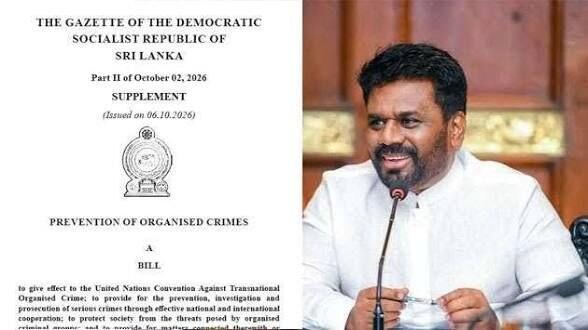
Two opposition politicians have warned that the proposed Prevention of Organised Crime Bill could be used against ordinary people and political dissent, arguing that its definitions and detention powers are too broad.
Frontline Socialist Party (FSP) Education Secretary Pubudu Jayagoda told a media briefing at the party office in Nugegoda that the Bill, gazetted on October 6, had been presented to Parliament alongside other legislation which, he claimed, would widen the State’s powers. He said it should be assessed together with the proposed counter-terrorism Bill and the 22nd Amendment.
According to Jayagoda, the Bill defines an “organised criminal group” as a structured group of three or more people acting together over a period of time to commit one or more serious offences for financial or other material gain. A “serious offence” is one that carries a prison sentence of four years or more, and he said the Schedule includes offences such as obstructing a police officer, theft, copyright infringement and unlicensed gambling.
He criticised Section 4(2), which he said could allow a person to be identified as a member of a criminal group on the basis of clothing, gestures, language or tattoos. He asked whether young people with long hair or tattoos could face arbitrary arrest and detention as a result.
Jayagoda also raised several provisions on detention. Under Section 20(1), he said, police could hold a suspect for up to 72 hours without producing the person before a Magistrate. Section 21 would allow detention orders of two months at a time, up to a maximum of one year, to be issued by the Secretary to the ministry responsible for police on a police request. He said Section 23 removes the Magistrate’s power to grant bail, Section 25 would allow a remanded suspect to be held in isolation at a police station for up to six months, and Section 47 effectively brings back the use of a confession made to police as evidence.
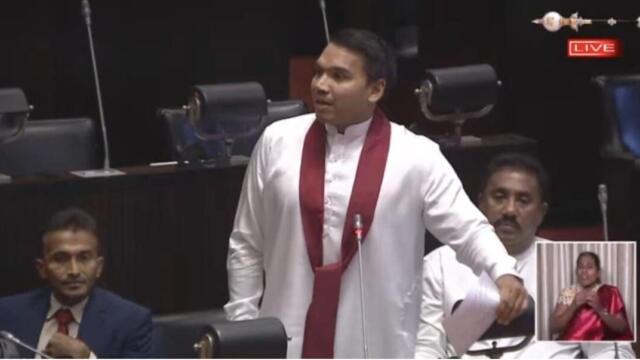
Separately, SLPP MP Namal Rajapaksa, who attended Parliament from remand custody, warned that the Bill could pave the way for repressive practices similar to those of 1988–89. Referring to the Justice Minister’s explanations about tattoos and other characteristics linked to criminal groups, he asked: “Do you need a new law to arrest someone who has a tattoo displaying the symbol of an organised criminal gang?” He alleged that the Government was introducing repressive measures under the guise of tackling organised crime, and urged it to focus instead on unemployment and the rising cost of living.
Background
Rajapaksa pointed to continuing shootings and ඝාතන linked to organised crime, which is the problem the Bill is meant to address. The 1988–89 period he referred to is widely recorded in Sri Lanka as a time of mass ඝාතන and enforced disappearances during the State’s response to the second JVP insurrection.
In Sri Lanka, a Bill is gazetted before it is placed on the Order Paper of Parliament, debated and put to a vote. Citizens and organisations may challenge a gazetted Bill in the Supreme Court on constitutional grounds.
What it means
The provisions described by the critics are still proposals, and the Bill has not been passed. The concerns they raise are practical ones: whether a person’s appearance, such as a tattoo, could be treated as grounds for suspicion, and how long someone could be held before seeing a judge.
Readers who want to judge the claims for themselves can read the gazetted text of the Bill, and the sections cited above, while it is debated in Parliament.