Wildlife Department Director General Ranjan Marasinghe said on Tuesday that Sri Lanka’s high wild elephant density, limited land area and growing human settlements make elephant conservation a major challenge, as an Opposition MP accused the Environment Minister in Parliament over the shooting of the tusker Kavantissa.
Marasinghe, who heads the Department of Wildlife Conservation, told a television programme that the country has an estimated wild elephant population of more than 7,000. He said this is the second-largest population of Asian elephants after India, although differences in land area and geography make direct comparisons difficult.
He said elephant density in Sri Lanka is approximately 10 times that of India. India’s land links with neighbouring countries allow elephants to cross national borders, while Sri Lanka’s island geography limits such movement, he said.
Marasinghe named habitat fragmentation as a major cause of human-elephant conflict. Roads, and the settlements that develop along them, can divide habitats, cut traditional movement routes and bring elephants and people into closer contact, he said. The country’s high human population density further complicates efforts to protect habitats while meeting community needs.
“Unless we take action to address human-elephant conflict itself, no amount of effort focused on individual animals will be enough to prevent these issues,” he said. He said a comprehensive programme is being implemented and that the government aims to move beyond reacting to incidents involving individual elephants.
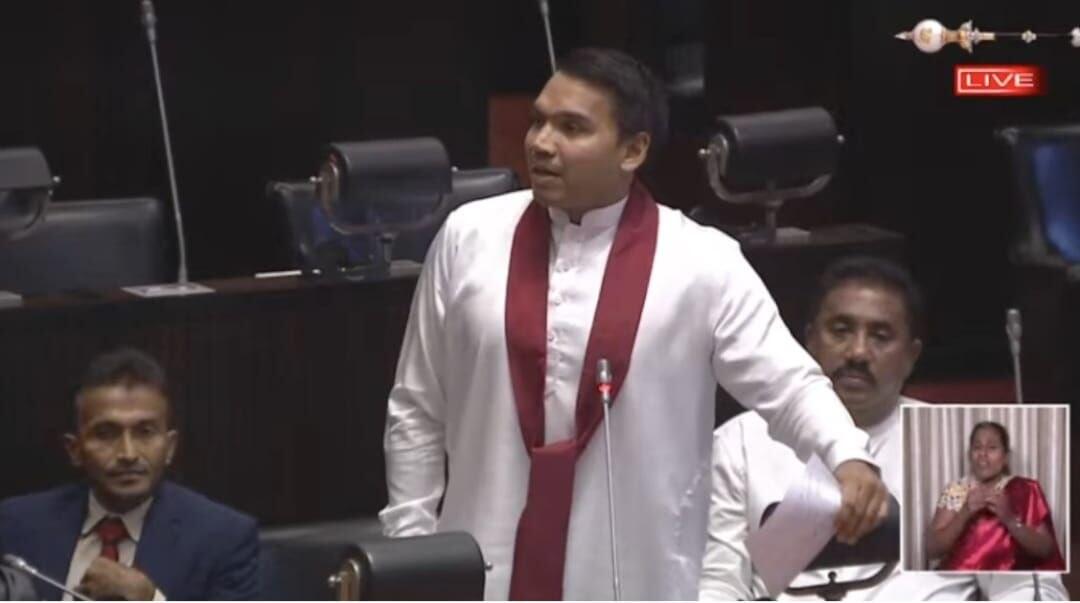
In Parliament on Tuesday, Namal Rajapaksa, a Member of Parliament, alleged that Environment Minister Dr. Dhammika Patabendi supplied firearms used to shoot animals approaching chena cultivations, field huts and houses. “Who provided the guns? Your Minister supplied the firearms,” he said.
Rajapaksa accused the Environment Ministry of failing for more than a month to give adequate attention to the shooting of Kavantissa. He said those responsible for the shooting, those who supplied the weapons and those protecting them would eventually be exposed. The Daily Mirror noted that the allegations about the supply of firearms require clarification from the relevant authorities.
He urged the government to use technology to monitor elephants and prevent similar incidents. Referring to the search for the elephant Agbo, he asked why funds could not be allocated to set up an effective elephant-monitoring system.
Background
Human-elephant conflict is a long-running problem in Sri Lanka, with elephants entering farmland and villages in search of food and people responding with fences, noise and, at times, firearms. Killing a wild elephant is a criminal offence under the Fauna and Flora Protection Ordinance. The Wildlife Department is responsible for enforcing the law and managing elephant habitats.
The government has said in Parliament that multiple investigations into Kavantissa’s death are under way. The Environment Ministry has not been quoted in the reports on Rajapaksa’s allegation.
What it means
For farmers and villagers in affected districts, the Director General’s remarks point to a policy focus on the wider conflict, including habitats and settlement patterns, rather than only on individual animals. Whether the firearms allegation is substantiated will depend on the investigations and on any response from the Minister.