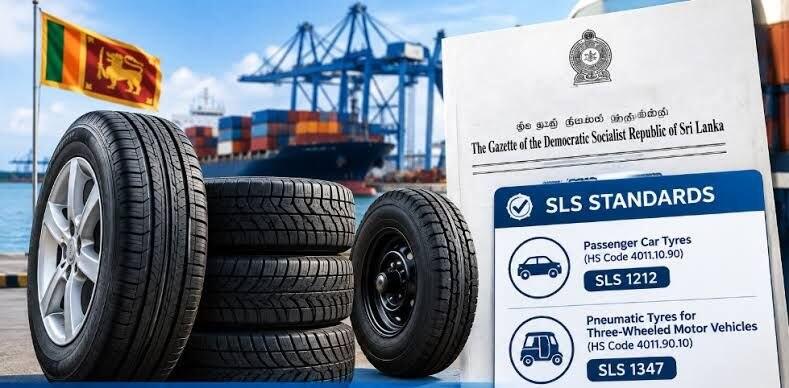
The Cabinet of Ministers has approved a proposal to present new import regulations to Parliament that make Sri Lanka Standards (SLS) testing mandatory for imported passenger car tyres and for pneumatic tyres for three-wheelers.
The regulations are the Import and Export (Control) Regulations No. 08 of 2026. The proposal was submitted by the President in his capacity as Minister of Finance, Planning and Economic Development, on the recommendation of the Ministry of Industries and Entrepreneurship Development.
The rules were issued through Extraordinary Gazette Notification No. 2508/27 on 1 October 2026. They amend the existing standardisation requirements for imports.
Under the new rules, imported passenger car tyres classified under HS Code 4011.10.90 must comply with Sri Lanka Standard 1212. Pneumatic tyres for three-wheeled vehicles, classified under HS Code 4011.90.10, must comply with Sri Lanka Standard 1347.
According to the Cabinet decision, the measures are intended to create a fair competitive environment for domestic tyre manufacturers while protecting consumer safety and quality assurance. The decision was announced in the Cabinet media statement issued on 19 October 2026, and the regulations now go before Parliament for approval.
Background
The Import and Export (Control) Act allows the government to regulate what may be brought into and taken out of the country, including by setting conditions on particular goods. Regulations of this kind are published in the Gazette, and Parliament is then asked to approve them.
The Sri Lanka Standards Institution (SLSI) is the national body that publishes Sri Lanka Standards and tests products against them. A Sri Lanka Standard sets out the technical and safety requirements that a product must meet, and mandatory standards mean that goods covered by them cannot be imported or sold unless they pass.
HS codes are the product classification numbers used in customs. The two codes in the regulations identify new pneumatic tyres of the kinds used on passenger cars and on three-wheelers, which are widely used as taxis and for small goods transport in Sri Lanka.
What it means
Importers of car and three-wheeler tyres covered by the two codes will have to show that their products meet SLS 1212 or SLS 1347, as applicable, before they can bring them into the country. Tyres that do not meet the standards would not be cleared for sale.
For vehicle owners, the stated aim is that tyres on the market meet a recognised safety and quality standard. Whether the rules change tyre prices or supply will depend on how many imported brands already comply and how testing is carried out, which the Cabinet statement did not address.
Domestic manufacturers are described in the decision as the intended beneficiaries of a level playing field. Parliament’s approval is the next step before the regulations are fully in force.