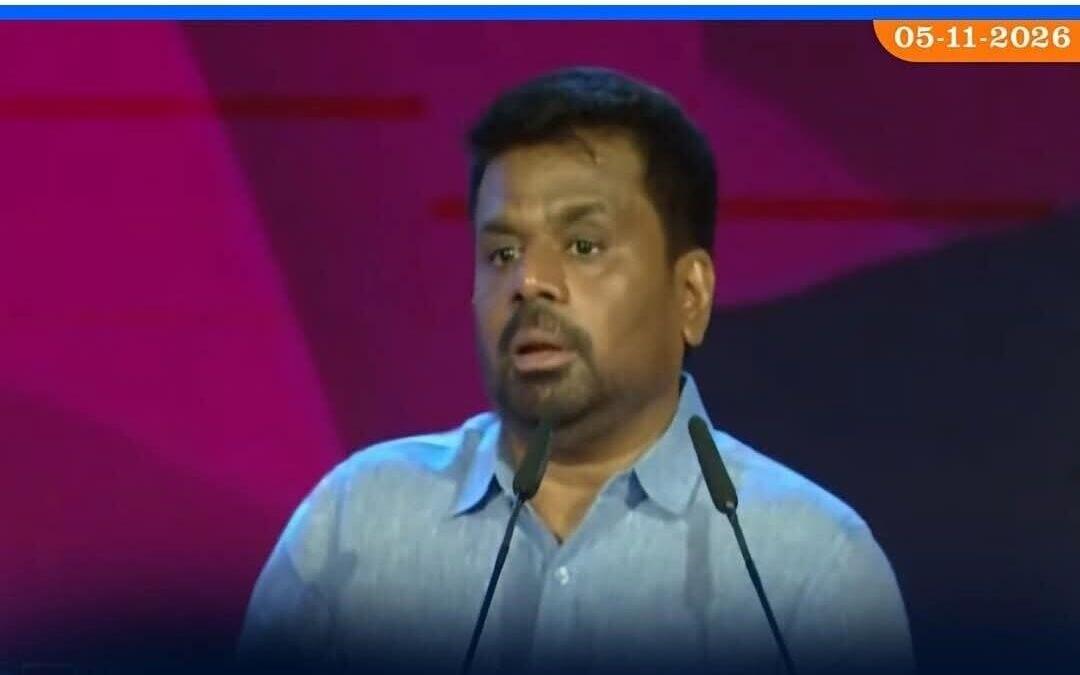
President Anura Kumara Dissanayake has said a “shadow state” built on drug money has emerged inside Sri Lanka, with traffickers and organised gangs allegedly influencing politicians, police officers and public officials.
He was speaking at a religious summit at Temple Trees on Thursday, held to mark the first anniversary of the national anti-drug operation, “Ratama Ekata”.
The President said traffickers had gathered enough wealth to reach into state institutions. He alleged that drug money had been used to influence officials at the Customs Department, the Department of Motor Traffic, the Department of Immigration and Emigration and the Police. He also claimed traffickers had financed political movements and won seats in local government bodies.
The President said narcotics worth about Rs. 218 billion had been seized over the past year, rising to Rs. 224 billion when cannabis is counted. Seizures included 6,528 kilograms of crystal methamphetamine (ICE) and nearly 4.5 million drug tablets and capsules. About 150 kilograms of heroin and ICE had been seized earlier on Thursday, he said.
He said 67 people linked to organised crime had been brought back to Sri Lanka from overseas in the past year, and red notices had been issued against 112 others. Assets worth about Rs. 4.5 billion, allegedly acquired through drug trafficking, had been frozen.
According to the President’s Media Division, firearms seized from criminal networks included 97 T-56 assault rifles, 143 pistols, AK-47 rifles and 105 revolvers. The President said some weapons had come from the armed forces, citing audit reports, and referred to police officers allegedly selling firearms.
Background
“Ratama Ekata” (“Together as a country”) is the government’s national campaign against drugs and organised crime. The President said only one person under 18 was arrested in connection with ICE in 2022, compared with 1,874 in 2025. He said the Ministry of Education was preparing awareness programmes for parents.
The President also said the government is ready to make three changes to the proposed Prevention of Organised Crimes Bill after concerns were raised before the Supreme Court. The detention period would be cut from 72 hours to 48 hours. Provisions on identifying gang members by tattoos would be removed, as would the Bill’s application to offences under the Excise Ordinance. He said the government would discuss other concerns raised by those defending democracy and fundamental rights.
He said the government intends to substantially reduce the powers of the Prevention of Terrorism Act (PTA). The PTA had been used against organised criminals, he said, because existing laws were inadequate for certain offences. He added that suspects must be investigated, prosecuted and punished through the courts, and that the government would not punish anyone outside the law.
What it means
The proposed changes to the organised crimes law would shorten the period for which a suspect can be held before being produced before a court, if Parliament approves them as announced.
The President urged Buddhist monks, Christian clergy, Muslim religious leaders and Hindu priests to help change attitudes towards drugs and to support affected families. He launched a website for the campaign, www.1818.gov.lk, and said the drug problem could not be removed in one or two years but could be tackled through sustained effort over several years.