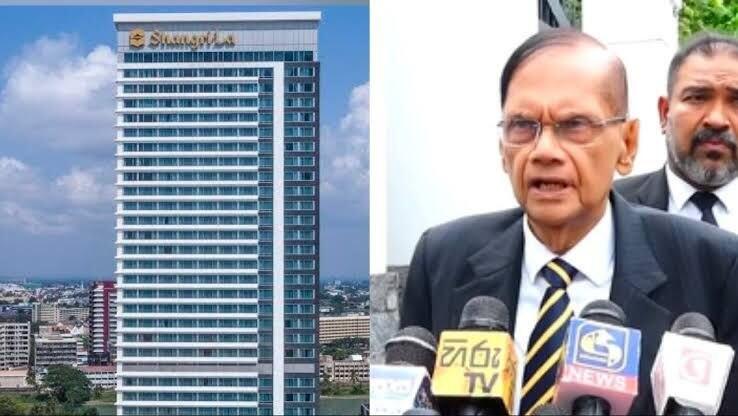
Former Foreign Minister Prof. G.L. Peiris was questioned for about two hours by the Commission to Investigate Allegations of Bribery or Corruption (CIABOC) on Tuesday (20 October) over the Shangri-La Hotel investment in Sri Lanka.
The Daily Mirror reported that Peiris left the commission’s premises after giving a statement in connection with an ongoing investigation. He appeared in response to an official notice requesting a statement about an inquiry into a meeting held while he was Minister of Foreign Affairs.
Peiris told the media that the commission had summoned him only to obtain information about the circumstances of the investment and the government’s role at the time. He said he had not been accused of any wrongdoing in the matter.
According to Peiris, he assumed duties as Foreign Minister on 23 April 2010, several months after the end of the civil war, when Sri Lanka was facing economic difficulties and struggling to attract foreign investment. He said representatives of the Shangri-La hotel chain had expressed interest in opening a hotel in Sri Lanka and asked how the government would respond to a proposed visit.
Peiris said he referred the matter to then-President Mahinda Rajapaksa because he believed the decision needed approval at the highest level. He said Rajapaksa welcomed the proposal and told him to encourage the investors to visit, pointing to the improved security situation after the war.
He said promoting tourism was among the responsibilities assigned to him by an extraordinary gazette notification issued after he took office. The government encouraged the investment, he said, because it was expected to attract high-spending international tourists and strengthen investor confidence.
Background
The Commission to Investigate Allegations of Bribery or Corruption is the state body that investigates complaints of bribery and corruption. It can summon people to give statements, and being asked to give one does not by itself mean a person has been accused of an offence.
Peiris argued that the arrival of Shangri-La helped build confidence among other international hotel operators, and cited later developments such as the ITC Ratnadipa Hotel in Colombo. He said the Colombo area had changed significantly since 2010, with new hotels, roads and other infrastructure.
The civil war ended in May 2009. Sri Lanka’s tourism industry has been a major source of foreign currency, and large hotel projects in Colombo have often involved government approvals at several levels.
What it means
The commission has not announced any finding or charge in connection with the inquiry. Based on what Peiris and the Daily Mirror reported, the questioning concerned the circumstances in which the investment was encouraged, not an allegation against him.
Readers should treat the matter as an ongoing inquiry. Any further steps, such as statements from other former officials, would be for the commission to decide.