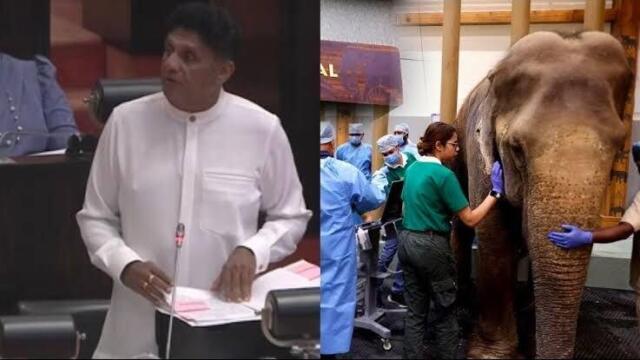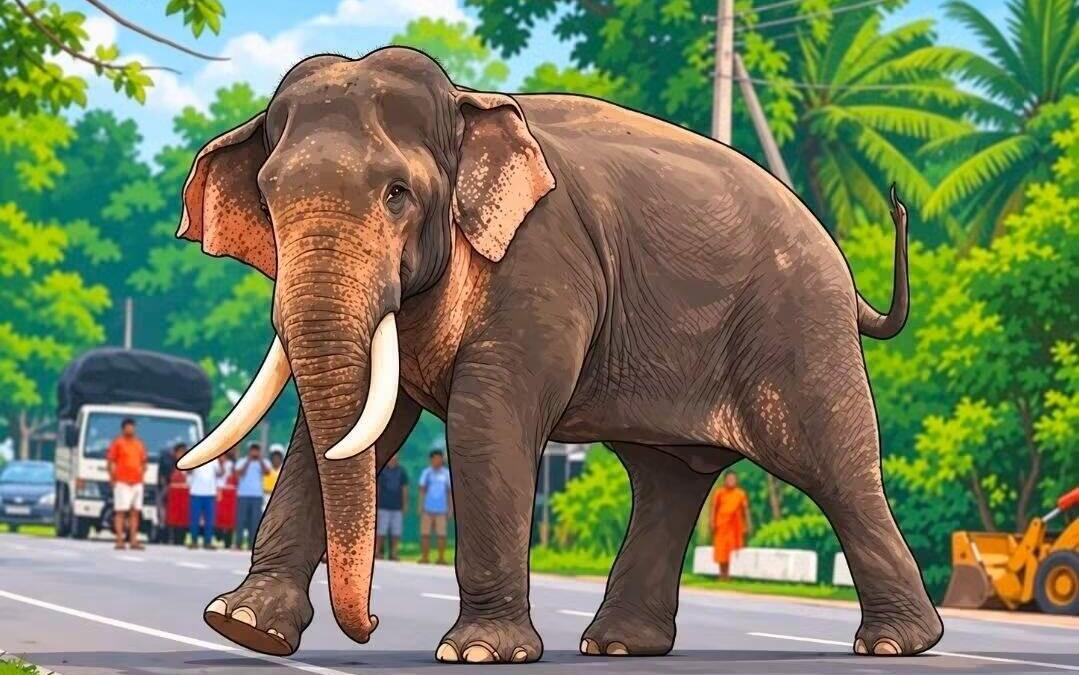
Environment Minister Dhammika Patabendi told Parliament on Tuesday that the wild tusker Kavantissa died of gunshot injuries, as investigators continue to examine whether a conspiracy lay behind the shooting.
The Minister said the elephant had initially recovered but fell ill again before it died on Friday, 16 October. Advice had been sought from veterinary experts in Thailand and India during the treatment, he said. Kavantissa had been treated for weeks for a gunshot wound to its right foreleg.
Environmental organisations and wildlife activists protested outside the Ministry of Environment on Tuesday. They asked the government to bring those responsible to justice and to introduce measures to protect Sri Lanka’s wild elephants.
Relatives of the suspects have rejected the case against them. The wife of one suspect, who said she and her husband are government employees with two children, alleged that about 15 officers came to their home at around 4.30 p.m. and pressed him to admit to the shooting. “My husband told them that he could never admit to something he had not done,” she said. She said the family had spent a considerable sum on an electric fence to keep elephants away and that the firearm taken by investigators was licensed and registered.
A relative of another suspect alleged that officers of the Walana unit arrested several men, including his brothers, who had no part in the shooting. He also alleged that one of those arrested was assaulted in custody and taken to hospital with an ear injury. These allegations have not been independently verified.
Background
The Mahawa Magistrate’s Court heard the case on Monday, 19 October. Magistrate Anuradha Seneviratne questioned wildlife officials about the evidence against the suspects and directed investigators to present further material. Two suspects were remanded until 28 October.
The Ministry of Environment has said its investigations have established a link between a main suspect and the shooting, and police have reported recovering firearms and ammunition.
Separately, Isuru Hewakottage, a veterinary surgeon in the North Western Wildlife Zone who treated Kavantissa, has submitted letters to the Director General of Wildlife Conservation to resign from his post, the Daily Mirror reported. He reportedly said continuing public criticism on social media after the elephant’s death had affected his work and personal life. Tharaka Prasad, a retired Department of Wildlife Conservation veterinary surgeon who previously served as Director of Wildlife Health, said wildlife veterinarians give medication only in prescribed doses. The Director General of Wildlife Conservation, Ranjan Marasinghe, could not be reached for comment, the newspaper said.
Wild elephants are protected in Sri Lanka under the Fauna and Flora Protection Ordinance, and killing one is a criminal offence.
What it means
The case will continue before the Mahawa Magistrate’s Court, where the magistrate has asked investigators for more evidence before the suspects’ next appearance on 28 October.
For rural communities that live alongside elephants, the case brings together two concerns: the protection of a species that is a national symbol, and the rights of people held on suspicion of harming it. Courts require evidence linking each suspect to the offence, and the allegations made by the families will be tested in that process.