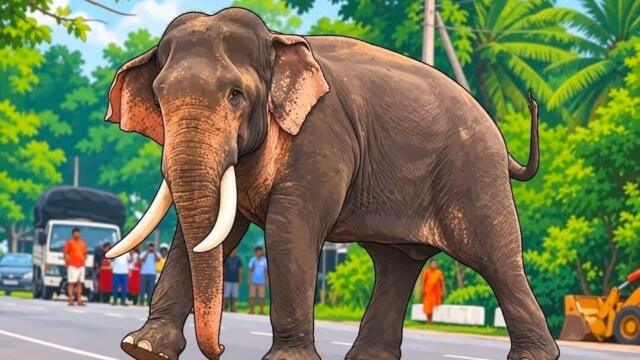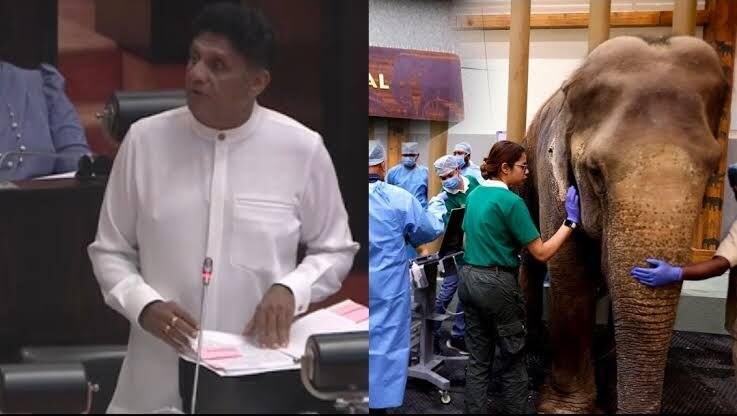
Opposition Leader Sajith Premadasa asked Parliament on Tuesday (20 October) to create a task force and a wildlife hospital to protect Sri Lanka’s remaining tuskers, after the death of Kavantissa.
Premadasa said the country needed a stronger emergency treatment system for injured wildlife, including modern veterinary facilities, diagnostic equipment, mobile laboratories and a rapid-response unit for elephants. He offered the opposition’s support, including help in securing foreign funding.
He proposed that the task force include experienced wildlife officers, among them Chathura Gunaratne and the investigation team led by Olugala, who were involved in an arrest connected to the shooting. He also asked that foreign veterinary specialists be brought in for complex cases, and that environmental groups and civil society representatives join the expert committee the government appointed to investigate Kavantissa’s death.
Premadasa said tuskers including Kandula, Walagamba, Dathusena and Genghis Khan had been killed in recent years and that the “culture” of killing them must stop. He also proposed a separate armed force to protect super tuskers, saying former Kenyan President Jomo Kenyatta had set up such a force in Africa.
Environment Minister Dhammika Patabendi told Parliament on the same day that Kavantissa died of gunshot injuries. He said the animal had initially recovered but fell ill again before its death, and that advice had been sought from veterinary experts in Thailand and India. Investigations were continuing to establish whether there had been a conspiracy to kill the tusker, he said.
Environmental organisations and wildlife activists also held a protest outside the Ministry of Environment, calling for those responsible to be brought to justice and for stronger measures to protect wild elephants.
Background
Kavantissa died on 16 October after weeks of treatment for a gunshot injury to its right foreleg. Premadasa said lessons from the deaths of Kavantissa, Bhathiya and Thekka Raja should be used to develop better treatment procedures and emergency response systems. He also pointed to shortages of wildlife veterinarians and other trained staff at the Department of Wildlife Conservation.
Several people have been arrested over the shooting, and the case is before the Mahawa Magistrate’s Court. On Monday (19 October), Magistrate Anuradha Seneviratne questioned wildlife officials about the evidence against the suspects and directed investigators to present further material to court.
The Ministry of Environment has said its investigations established a link between a main suspect and the shooting, and police have reported recovering firearms and ammunition. Families of some of the suspects deny any involvement. The wife of one suspect told the media that about 15 officers came to their home and pressured her husband to admit responsibility, and that the firearm seized was licensed and registered. A relative of another suspect alleged that one of the arrested men was assaulted in custody and treated in hospital for an ear injury. These allegations have not been independently verified.
What it means
The proposals are those of the opposition and have not been adopted by the government. Any new task force, hospital or change to the expert committee would need a decision by the government and the Department of Wildlife Conservation.
For now, the court case and the investigation into whether others were involved will decide who is held responsible. The Mahawa Magistrate’s Court has asked investigators for more material, and the families have called for an independent inquiry.