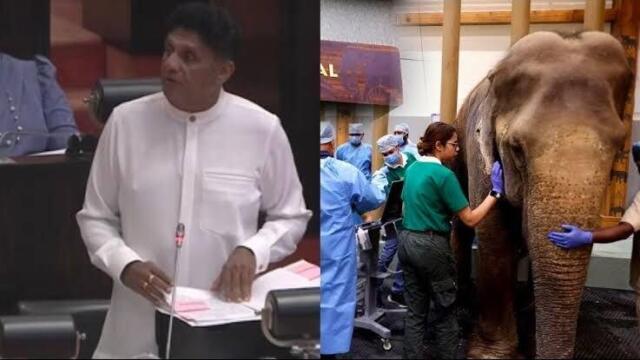
Tusker Kawantissa died of gunshot injuries, Environment Minister Dhammika Patabendi told Parliament on Tuesday, as the investigation into the shooting widened with more arrests.
The Minister said the elephant had initially recovered but fell ill again before it died. Advice had been sought from veterinary experts in Thailand and India, he said, and investigations were continuing to establish whether there was a conspiracy to kill the animal.
Kawantissa, regarded as Sri Lanka’s tallest living tusker, died on 16 October while being treated for a gunshot wound to its right foreleg. The animal was shot in a paddy field in Galgamuwa.
Five more suspects were arrested in a joint operation by the Department of Wildlife Conservation, the Walana Central Anti-Vice Strike Force and the local police, according to reports of the operation. They are being questioned by wildlife officers and Galgamuwa Police.
Police said an earlier arrest was a Skills Development Officer attached to the Ehetuwewa Divisional Secretariat, who is suspected of the shooting. Two locally made firearms and 24 rounds of ammunition were recovered from his residence, police said. The weapons were a 12-bore firearm and a muzzle-loading gun known as a cap gun.
The Ministry of Environment said investigations had linked the main suspect directly to the shooting. Investigators are also looking into reports that the same suspect had previously shot an elephant known as Diana, and into whether an organised syndicate hunting wild animals operates in the area.
Background
The case has drawn attention beyond the area where it happened. On Tuesday, environmental organisations and wildlife activists protested outside the Ministry of Environment, calling for action against those responsible and for stronger protection of wild elephants.
The arrests have also been disputed. Relatives of some suspects told the media that innocent people had been implicated. The wife of one suspect alleged that around 15 officers came to their home at about 4.30 p.m. and pressed her husband to admit to the shooting. She said her husband, like her, was a government employee and that the firearm seized was licensed and registered.
A relative of another suspect alleged that officers from the Walana unit arrested several men, including his brothers, who had no part in the shooting, and that one of the men was assaulted in custody and taken to hospital with an ear injury. These allegations have not been independently verified.
The Mahawa Magistrate’s Court heard the case on Monday. Magistrate Anuradha Seneviratne questioned wildlife officials on the evidence against the suspects and directed investigators to present further material. Two suspects were remanded until 28 October.
What it means
For now, the courts and investigators will decide who was responsible. The suspects have not been convicted of any offence, and the claims made by their families remain allegations that police have not been reported as answering in the material available.
The Environment Ministry said several agencies would continue joint operations to enforce the law against activities that threaten wildlife. For farming communities in areas with wild elephants, the case also touches on a long-running problem: families often spend heavily on measures such as electric fences to protect crops and homes, while conservationists say shooting elephants is illegal and endangers a protected species.
Further court hearings and the outcome of the conspiracy inquiry the Minister described will show whether more people are charged.