Credit extended to Sri Lanka’s private sector reached Rs. 2.1 trillion in the first nine months of 2026, up from Rs. 1.9 trillion a year earlier, Central Bank officials told Parliament’s Committee on Public Finance (COPF).
Central Bank of Sri Lanka (CBSL) Governor Dr. P. Nandalal Weerasinghe and other senior officials attended the meeting, held in Parliament under the chairmanship of MP Dr. Harsha de Silva. Deputy Minister Chathuranga Abeysinghe and several MPs also took part.
Officials said about 74 percent of the private sector credit was provided by licensed commercial banks. The committee raised concerns about the make-up of lending, noting that the share of short-term loans rose from 42 percent to 47 percent, while the share of long-term loans fell from 35 percent to 29 percent.
Members asked whether bank lending was being directed sufficiently towards capital formation, new investment and expanded production capacity. The growth of different loan categories, including mortgage and vehicle loans, was also discussed.
On financial stability, officials said the banking sector’s Stage 3 non-performing loan ratio had declined from 9.7 percent to 8.8 percent, and that capital and liquidity levels remained above regulatory requirements.
Background
The Central Bank explained its decision to keep the headline inflation target, measured by the Colombo Consumer Price Index (CCPI), at 5 percent over the next three years. Officials told the committee that seven special reports had been submitted to Parliament on occasions when inflation stayed below the lower limit of the 3 percent target range.
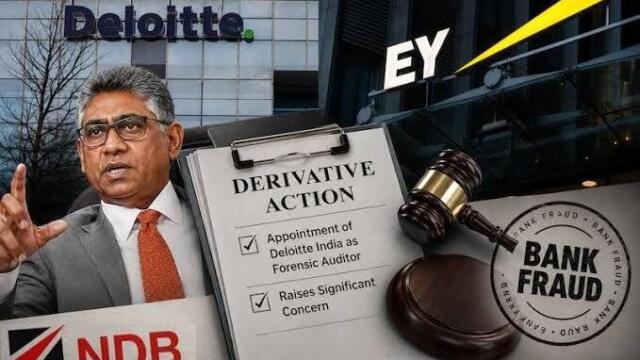
On NDB Bank, officials said a forensic audit of the bank, together with the report of the Sri Lanka Accounting and Auditing Standards Monitoring Board, was referred to the Attorney General on 15 October 2026. They said regulatory measures had also been imposed on the bank, including restrictions on dividend payments, branch expansion and directors’ remuneration.
The committee also discussed institutions that accept public deposits illegally, and financial scams that use artificial intelligence to create fake images and voices of the Central Bank Governor, the Prime Minister and MPs. Officials said they were working with the Telecommunications Regulatory Commission, the Sri Lanka Computer Emergency Readiness Team (CERT), the police and Meta to prevent such scams.
Longer-term growth was another subject. The discussion stressed the need for reforms in the trade, labour and land sectors alongside appropriate monetary policy, as well as human capital development, higher productivity and foreign direct investment.
Stage 3 loans are those that banks classify as credit-impaired under accounting rules, and the ratio is one of the measures regulators use to judge the health of the banking system.
What it means
For borrowers and businesses, the shift towards short-term lending matters because long-term loans are generally what finance factories, machinery, housing and other projects that take years to pay back. A smaller share of such loans means less of the credit being offered is tied to that kind of investment, which is the concern MPs raised.
For depositors, the officials’ figures on capital, liquidity and falling bad loans point to a banking system that remains within regulatory limits. Members of the public are also being warned about fraudulent schemes that use fake voices and images of senior officials, and about unlicensed institutions that take deposits.