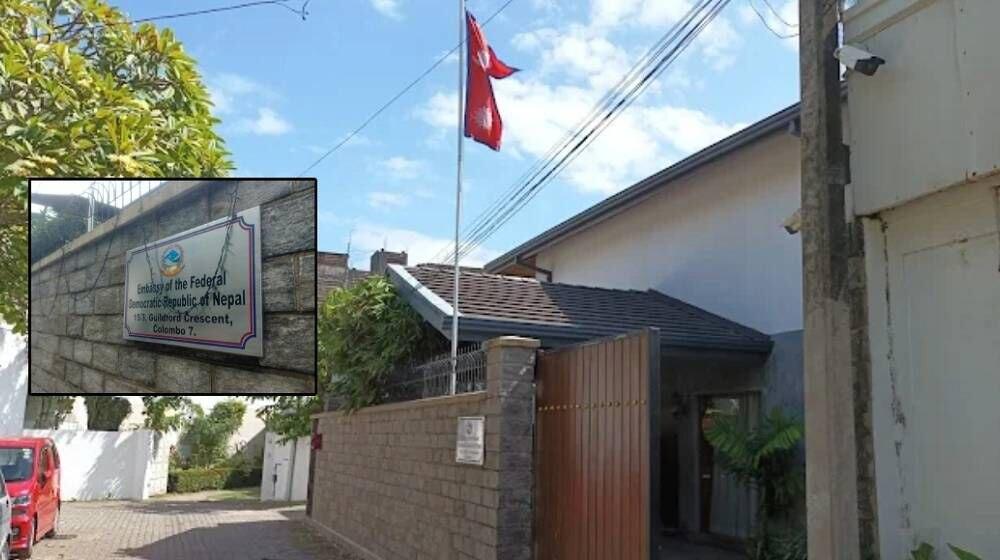
Nepal has begun steps to recover land in Colombo that was allegedly sold to private buyers without government authorisation by its former honorary consul more than three decades ago, according to Nepalese media reports.
Nepal bought 1.5 acres in Rajagiriya, Colombo, on 18 May 1989 for US$360,000 to set up an embassy, the Nepalese news outlet Onlinekhabar reported.
One acre was allegedly sold in two transactions by Albert Edirisinghe, then Nepal’s honorary consul general in Sri Lanka, who has since died. The report said the land was first sold in September 1990 for US$100,000 and passed to another person in May 1994 for US$120,000.
Nepal’s Ministry of Foreign Affairs told Parliament that it had found no documents authorising the former honorary consul to sell the property, the report said.
The alleged sales went unnoticed for more than 30 years. Nepalese officials learnt of them on 5 June 2025 while trying to clear and fence the land, according to the report.
The matter was then brought to the attention of Sri Lanka’s Ministry of Foreign Affairs and an investigation was launched. Nepalese lawmaker Nishkal Rai has estimated the current value of the property at about US$6.5 million.
Sri Lankan authorities advised the Nepalese mission to take measures to secure the property and establish ownership, the report said. Nepal is continuing discussions with Sri Lankan authorities, and investigations into the alleged unauthorised transfers are ongoing.
The information has not been independently verified.
Background
Honorary consuls are usually private citizens appointed by a foreign government to represent its interests in a country, often in a limited role such as assisting travellers or promoting trade. They are not career diplomats, and their authority to deal in state property is normally restricted by the appointing government’s own rules.
Property bought by a government for an embassy is state property of that country. Ownership of land in Sri Lanka is recorded in the land registry, and a change of ownership needs a deed that is registered. Establishing who now holds the title, and whether the earlier transfers were valid, would be a matter for Sri Lankan law and the courts if the parties cannot settle it by discussion.
The reports do not say who holds the land today.
What it means
The case is a dispute between a foreign government and private parties over land in a Colombo suburb, and no court proceedings have been reported. For now, the practical effect is limited to the parties involved and to Sri Lanka’s Ministry of Foreign Affairs, which has been asked to help.
It also shows why buyers and sellers of property are advised to check the title history and the authority of whoever signs a sale, particularly where the owner is a government or a company. The Registrar General’s Department keeps the registers on which such checks rely.