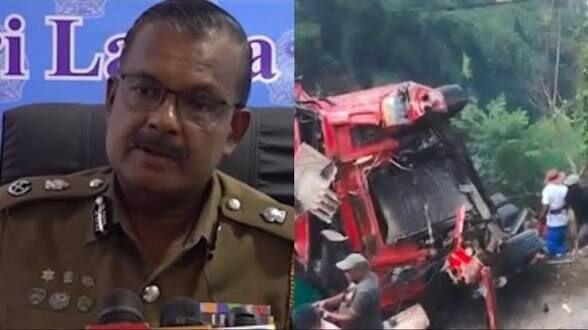
Six people were killed and seven injured when a cement-laden bulker lorry ploughed into several vehicles and a shop on the Kandy-Jaffna A9 road at Kurugoda, Akurana, on Monday morning (19).
Alawathugoda Police said the crash happened at about 10.30 a.m. Four of the victims, two women and two men, died on the spot. Five of the injured were taken to the National Hospital of Kandy, where hospital sources said two remained in critical condition. The bodies of the four who died at the scene were placed at the Akurana Hospital, where two others with minor injuries were also being treated.
Police said the lorry was travelling at high speed when it struck a number of three-wheelers, motorcycles and other vehicles before veering off the road and crashing into a commercial establishment. Deputy Inspector General (DIG) of Police W. P. J. Senadheera, who is in charge of Traffic Control and Road Safety, said the driver lost control while negotiating a left-hand bend near Kurugoda Junction. The lorry first hit a motorcycle and dragged it for about 160 metres.
The driver was arrested by the Alawathugoda Police Traffic Division and is to be produced before court under the relevant criminal and motor traffic laws. Investigations are being conducted under the supervision of Central Province Senior DIG Lalith Pathinayake.
“The driver claims that the brakes failed and that he was unable to control the vehicle. We are conducting a full investigation to establish whether this was actually the cause of the accident,” DIG Senadheera said.
He said the driver tested negative for alcohol, but arrangements have been made for a drug test. Police are also checking whether the driver fell asleep at the wheel. A motor vehicle examiner’s report and a Government Analyst’s report will be obtained to establish whether a mechanical defect contributed to the crash.
Background
The A9 is one of the country’s main arterial roads, linking Kandy with the Northern Province. It carries a heavy mix of buses, goods lorries, three-wheelers and motorcycles, and passes through busy town centres where shops and pedestrians sit close to the carriageway.
Under Sri Lankan law, a driver is responsible for ensuring that a vehicle is roadworthy before it is taken onto the road. DIG Senadheera said that before setting out, a driver must check the brakes, lights and other essential components.
The DIG also said authorities are preparing proposed regulations that would require mandatory vehicle fitness certification every three months or after 5,000 kilometres of travel. Details of the proposal, including which vehicle categories would be covered and when it could take effect, have not been announced.
What it means
The findings of the vehicle examiner and the Government Analyst will determine whether the driver’s brake-failure claim stands, and that could shape the charges he faces.
For heavy-vehicle operators, the proposed fitness checks, if introduced, would mean more frequent inspections. Road users on the A9 and other busy routes may see closer attention to the condition of goods vehicles as the investigation continues.