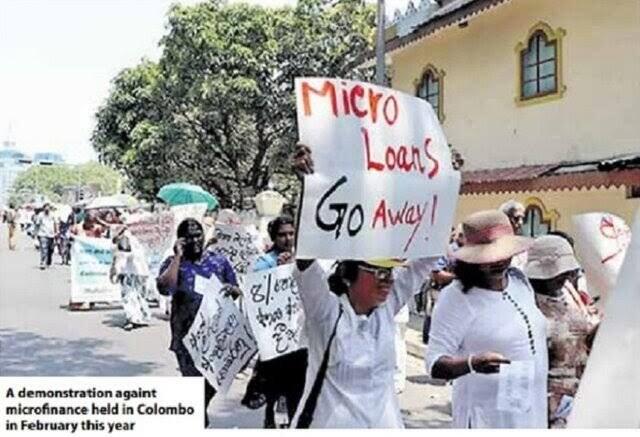
A parliamentary oversight committee has called for the speedy implementation of the Microfinance and Credit Regulatory Authority Act, to regulate lending institutions and protect borrowers from excessive interest rates.
The Sectoral Oversight Committee on Economic Development and International Relations, chaired by MP Lakmali Hemachandra, discussed the matter at a recent meeting with representatives of the Sri Lanka Microfinance Practitioners’ Association, according to Parliament.
Members paid particular attention to lenders that charge very high interest through informal practices, which Parliament said has caused financial hardship to the public.
The committee said a fair regulatory framework is needed, while properly functioning microfinance institutions should be able to continue operating. The discussion covered simplifying licensing procedures, allowing regulated microfinance institutions to accept limited public deposits under supervision, and giving them access to lower-cost funding.
The committee also considered whether concessional funding could be secured from international institutions, including the Asian Development Bank, to help bring interest rates down. It examined consumer protection measures, the proposed Regulatory Authority and the deadlines for institutions to obtain licences.
At the same meeting, the committee discussed a request by the state-owned Lanka Mineral Sands Limited (LMSL) for exclusive mining rights over 68 grids containing mineral sand deposits along the north-eastern coastline. LMSL asked that these deposits not be allocated to private institutions.
The committee also reviewed concerns over mining licences issued earlier, including alleged irregularities. It noted that information on certain irregularities has been referred to the Criminal Investigation Department (CID).
The committee decided to issue recommendations on mining rights and operational support for LMSL, and to consider measures to make future mining licence approvals more transparent.
Background
Microfinance institutions lend small sums, often to low-income households, small traders and farmers who may find it hard to borrow from banks. Many small lenders operate outside the direct supervision of the Central Bank of Sri Lanka, which regulates licensed banks and licensed finance companies.
Without a dedicated regulator, borrowers have had limited recourse when interest charges and fees rise sharply. The committee’s call is aimed at bringing such lenders under a licensing and supervision system.
Lanka Mineral Sands Limited is a state-owned company. Its best-known operations are mineral sand mining at Pulmoddai in the Trincomalee District, on the north-eastern coast. Mineral sands are a source of ilmenite, rutile and zircon, which are used in industry.
What it means
For households that borrow from small lenders, a licensing regime could set clearer rules on what lenders may charge and how they must treat customers. The committee said it wants regulated institutions to keep operating, so access to small loans is not expected to be cut off.
The committee’s recommendations are not binding. Whether they lead to licensing deadlines or changes to mining rights will depend on decisions by the Government.