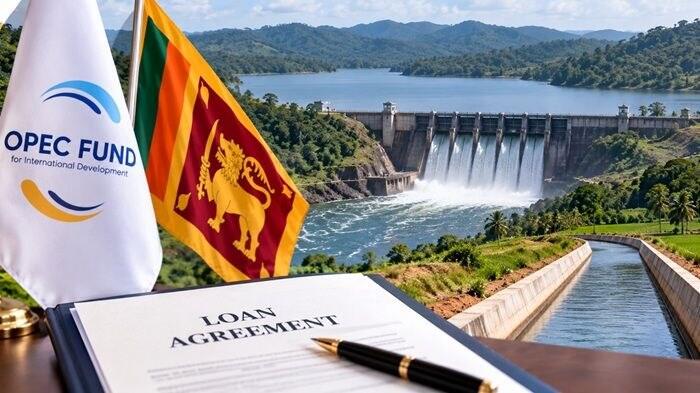
The Cabinet of Ministers has approved a US$30 million policy-based loan from the OPEC Fund for International Development to support Sri Lanka’s economic recovery and reform programme.
The loan has two parts: US$24 million under the fund’s Ordinary Capital Resources and US$6 million under its Special Capital Resources.
According to the Cabinet decision, the money will support the restoration of macroeconomic stability, fiscal sustainability and sustainable and inclusive economic growth.
The financing is meant to complement funding provided by the World Bank under the Sri Lanka Reforms for Growth, Resilience and Openness Development Policy Operation.
The proposal was submitted to the Cabinet by President Anura Kumara Dissanayake in his capacity as Minister of Finance, Planning and Economic Development.
Background
The OPEC Fund for International Development is a development finance institution based in Vienna that lends to developing countries. Despite its name, it lends for development projects and programmes in many sectors and is separate from the oil producers’ group OPEC.
A policy-based loan differs from a project loan. Rather than paying for a particular road or power plant, the money goes to the government’s budget in support of agreed reforms. Development policy operations of this kind are commonly used when a country is working to restore stability after a crisis.
Sri Lanka declared a suspension of repayments on its external debt in April 2022 during a severe foreign exchange shortage and later began an International Monetary Fund (IMF) supported programme and a debt restructuring. The World Bank operation named in the Cabinet decision is part of the wider set of reform-linked financing that has followed.
The Cabinet decision does not state the interest rate, the repayment period or the date on which the loan will be signed. Those terms are normally set out in the financing agreement between the Government and the lender.
What it means
The loan adds US$30 million to Sri Lanka’s external borrowing. Because it is budget support tied to reforms, it does not fund a specific project that readers would see on the ground, such as a hospital or a road.
For taxpayers, the practical effect depends on the final terms. Concessional lending, which carries lower interest rates and longer repayment periods than commercial borrowing, generally costs a government less over time, but the Cabinet decision does not say whether this loan is concessional.
Sri Lankans abroad who follow the country’s recovery may note that the loan is meant to sit alongside World Bank financing, so the reform conditions attached to it are likely to be linked to the same programme. Details of those conditions have not been published in the Cabinet decision.