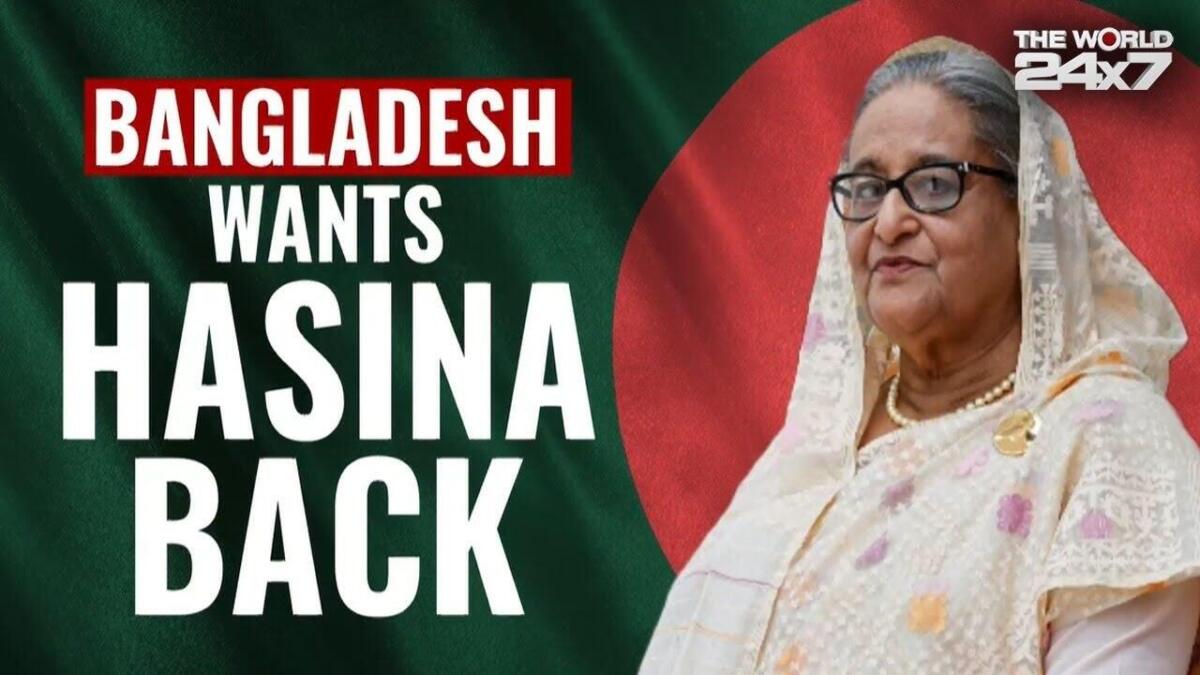
Bangladesh’s former prime minister Sheikh Hasina has said she plans to return home on 16 December, and Dhaka has replied that she would be brought back in handcuffs.
Hasina has lived in exile in Delhi since August 2024. Her spokesperson, Syed Mozammel Ali, said in a statement on Tuesday that she has asked the Bangladeshi government to arrange air transport for her from Delhi to Dhaka. He said she was flown to India on a Bangladesh aircraft on 5 August 2024 and that authorities forced her into exile in violation of the constitution.
Bangladesh’s State Minister for Foreign Affairs Humayun Kabir rejected the idea of a return on her own terms. “Sheikh Hasina will not be able to return to the country as an ordinary commercial passenger; she will be brought back in handcuffs,” he told a press briefing on Tuesday.
Kabir also accused Hasina and Delhi of fomenting recent unrest in Bangladesh and alleged that they were backing “terrorist activities” in the country. India’s foreign ministry did not immediately respond to a request for comment.
It is not clear how Hasina would travel. Last year a Bangladeshi court sentenced her to death in absentia for crimes against humanity over the crackdown on student-led protests that ended her 15-year rule. She denies the charges.
The date carries meaning. Bangladesh marks Victory Day on 16 December, the end of its 1971 war of independence from Pakistan, which was led by Hasina’s father, Sheikh Mujibur Rahman. Hasina’s aide Abu Obaidha Arin called the decision “deeply symbolic” and said he was confident she would celebrate the day “among her people”.
Background
Hasina fled to India on 5 August 2024 as tens of thousands of protesters reached Dhaka and crowds stormed her official residence. What began as student protests against quotas in government jobs became a mass uprising after a deadly crackdown. The United Nations estimates that up to 1,400 people were killed.
The Awami League, her party, was banned from political activity in May last year under the interim government led by Nobel Peace Prize laureate Muhammad Yunus, which took charge after her ouster. The party was then barred from contesting February’s general election. The Bangladesh Nationalist Party (BNP), its long-time rival, won that vote and Tarique Rahman became prime minister.
The ban has not ended street protests by Awami League supporters, who have also called for nationwide shutdowns to demand Hasina’s return. In August, on the second anniversary of her ouster, Hasina told journalists in Delhi over an audio link: “I know that they may put me in jail or they may kill me, anything may happen, but still I have to go back.”
In April, India’s foreign ministry said it was examining Bangladesh’s request to extradite her and wanted to “engage constructively with the new government and further strengthen bilateral ties”.
What it means
Hasina’s stay in India has been a point of friction between Delhi and Dhaka. India had close relations with her during her 15 years in power and hoped the new government in Bangladesh would offer a chance to reset ties, which fell sharply after her ouster. Nine months after taking office, Prime Minister Rahman has not visited India despite an invitation. He has travelled to China, Japan and Malaysia, and skipped the BRICS summit hosted by India in September.
For readers in Sri Lanka, the dispute is part of the politics of South Asia, where relations between neighbouring governments can shift trade, travel and regional diplomacy. No decision on how, or whether, Hasina will travel on 16 December has been announced.