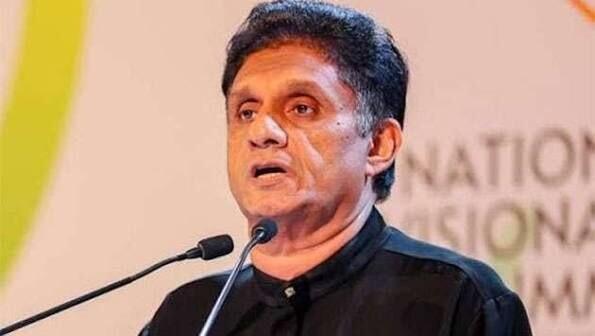
Opposition Leader Sajith Premadasa has called on Sri Lanka to adopt a foreign policy based on “positive alignments” with all countries, saying it should go beyond the country’s traditional non-alignment.
Premadasa, who leads the Samagi Jana Balawegaya (SJB), made the remarks while addressing Parliament on Monday. He said the SJB supported building constructive relations with as many countries and international institutions as possible, to help the country’s economic recovery and benefit its people.
He said Sri Lanka needed a coherent and proactive foreign policy that protected national interests, strengthened economic diplomacy and national security, and made effective use of the country’s strategic geographical position.
Premadasa set out 12 key pillars for assessing foreign policy. They included international cooperation, regional stability, trade, human rights, environmental protection and the welfare of Sri Lankans living overseas.
He also called for stronger regional cooperation through the South Asian Association for Regional Cooperation (SAARC), the Bay of Bengal Initiative for Multi-Sectoral Technical and Economic Cooperation (BIMSTEC) and the Indian Ocean Rim Association (IORA).
Premadasa stressed the need to protect Sri Lanka’s maritime resources while promoting sustainable development and strengthening regional partnerships. He proposed modernising foreign policy decision-making through new institutional structures and think tanks, to improve how policy is formulated and carried out.
The Opposition Leader said the Opposition would give constructive support to international initiatives that advance Sri Lanka’s national interests and benefit its 22 million people, regardless of political differences.
Background
Sri Lanka has long described its foreign policy as non-aligned, meaning it avoids formal membership of military blocs and seeks to keep relations with major powers on a balanced footing. Successive governments have said they follow this approach, even as the country’s economic and security ties with neighbouring and distant powers have changed over the years.
SAARC, BIMSTEC and IORA are regional groupings that bring together countries around the Indian Ocean and South Asia. Each covers a different set of members and issues, from trade and connectivity to maritime security.
What it means
Foreign policy shapes matters that reach ordinary households, including trade terms, access to markets, development financing and the support Sri Lankan embassies offer to citizens abroad. The inclusion of the welfare of Sri Lankans living overseas among Premadasa’s 12 pillars points to the part that migrant workers and the diaspora play in the economy and in public life.
Premadasa’s offer of constructive support signals that the SJB is willing to back foreign-policy initiatives on a case-by-case basis rather than oppose them by default. Whether the government takes up his proposals for new institutional structures and think tanks has not been stated.