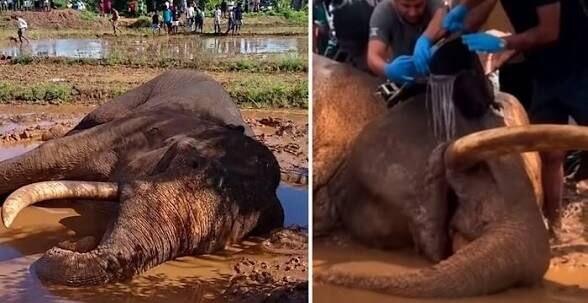
Tusker Kawanthissa died of a twisted intestine and its complications, not gunshot wounds, an interim post-mortem report told the Galgamuwa Magistrate’s Court on Wednesday.
The report, dated 6 November, was prepared by Professor R.R.M.K.K. Wijesundara of the Faculty of Veterinary Medicine and Animal Science at the University of Peradeniya, who carried out the examination. It named intestinal twisting, known as large intestinal volvulus, with septic shock and multiple organ complications, as the cause of death.
The report recorded three chronic wounds around the elephant’s right leg, with no pellets or bullet fragments inside them. Three pellets were found in the right abdominal and chest walls, but the report said they had not damaged any internal organs or bones.
Galgamuwa Magistrate Ravindra Ranjan Bandara observed that the findings raised questions that need further consideration. He rejected requests for an international panel of veterinary specialists to carry out further post-mortem examinations, observing that such a request should come from the prosecution rather than a third party. He also declined to move the investigation to the Department of Wildlife Conservation.
The court allowed wildlife photographer Pathum Bandara and the environmental organisation Voice for Bharhiya to intervene in the inquiry.
President’s Counsel Upul Jayasuriya, appearing for Pathum Bandara, told court the Director General of Wildlife Conservation should be held responsible for the elephant’s death. He said Rs. 1 billion allocated for elephant conservation in the previous Budget had largely gone unused, with only about 30 percent spent. He also questioned whether Kawanthissa received adequate follow-up care after veterinary treatment for an injury to its right front leg.
Jayasuriya said the interim report recommended an analysis by the Government Analyst to establish the nature of toxins detected in the animal’s body. He told court that experts in Thailand could carry out a further examination, and that his client was ready to arrange this through the Thai Embassy.
Attorney-at-Law Rohitha Rajakaruna questioned how the elephant came to have gunshot injuries, arguing that injuries to the lower abdomen could have occurred while the animal was lying on the ground. He asked that the Criminal Investigation Department (CID) take custody of firearms issued to the wildlife officers assigned to Kawanthissa and examine whether those officers and the veterinarians had carried out their duties properly.
Migalewa Wildlife Range Officer W.M.S.S. Weerakoon said the Department of Wildlife Conservation had made every possible effort to protect Kawanthissa and provide medical treatment. He described the allegations of negligence as baseless.
The Wildlife Department told court that the CID and the department are investigating the incident, and that a Presidential Commission has been appointed to inquire into the death. The CID has been noticed to appear before the court on 7 December.
Background
Intestinal volvulus is a condition in which part of the gut twists on itself and cuts off its own blood supply.
Wild elephants are protected by law in Sri Lanka, and the Department of Wildlife Conservation is the state body responsible for their protection and for treating injured animals. The interim report is not a final finding, and the Government Analyst’s analysis of the toxins it mentions has still to be reported.
What it means
The court has not ruled on whether any official was negligent. The pending toxin analysis, the Presidential Commission and the CID’s appearance on 7 December mean the inquiry remains open.
For the public, the findings so far give a medical cause of death, but not answers to the questions raised in court about treatment, conservation funds or how the animal was injured.