
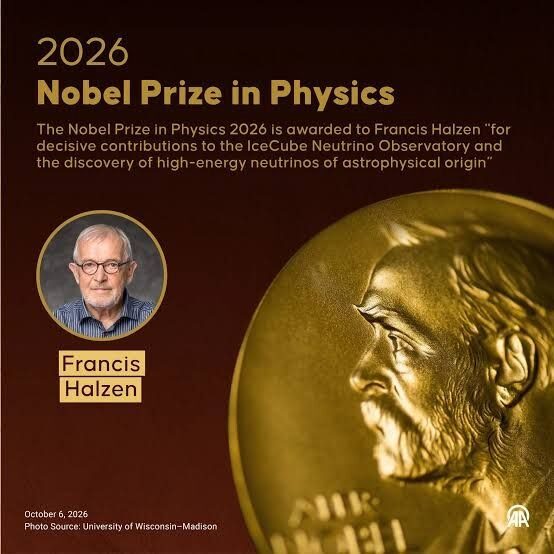
Belgian-born physicist Prof Francis Halzen has won the Nobel Prize in Physics for his work on the IceCube Neutrino Observatory at the South Pole, the Royal Swedish Academy of Sciences announced.
IceCube uses a cubic kilometre of Antarctic ice fitted with light sensors to detect neutrinos, subatomic particles produced by high-energy events far beyond the Solar System. Prof Halzen first set out his plan for the observatory in 1988.
The Academy said his vision and scientific leadership had been fundamental for the observatory. Prof Mark Pearce, Chair of the Nobel Committee for Physics, said Prof Halzen had led an international team that provided “a fantastic instrument” and that his work had “paved the way for a new kind of astronomy”.
Prof Halzen, now a US citizen working at the University of Wisconsin-Madison, told a news conference he was surprised the idea had worked so well. He said few people thought the project would succeed when it started.
Neutrinos rarely interact with matter. When one does strike an atomic nucleus in the ice, it produces charged particles that give off a faint blue light, which the sensors record to estimate where the neutrino came from.