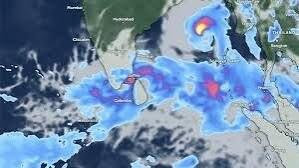
The Disaster Management Centre (DMC) has deployed rescue teams and equipment to areas at risk of severe weather as a depression in the Bay of Bengal is expected to become a cyclone.
DMC Director Pradeep Kodippili said all necessary arrangements had been made to respond to possible disasters linked to the rainy conditions. He said the preparations followed forecasts from the Department of Meteorology.
The Meteorology Department said the system became a deep depression by 11.30 a.m. on Sunday, centred near latitude 15.1 degrees North and longitude 91.0 degrees East. It is expected to move southwestwards, then turn gradually towards the west and north-west.
The department forecast that the system will develop into a cyclonic storm by the morning of Monday 26 October. It is likely to intensify into a severe cyclonic storm over the west-central Bay of Bengal by the morning of Tuesday 27 October.
The system is not expected to affect Sri Lanka directly. The department said wind patterns linked to it could bring more rain over the island, particularly in the south-west, over the next few days.
Heavy rainfall exceeding 100 millimetres is forecast in parts of the Northern, Western, Sabaragamuwa, Southern, North Western and Central provinces and in the Anuradhapura District. Showers or thundershowers may also occur in parts of the Uva Province and in the Ampara and Batticaloa districts after 1 p.m.
Winds of 40 to 50 kilometres per hour may blow at times over the western slopes of the Central Highlands, the Northern, North Central and North Western provinces, and the Trincomalee and Hambantota districts.
Background
The Department of Meteorology is the official source of weather forecasts and warnings in Sri Lanka. The Disaster Management Centre is the state agency that coordinates the response to floods, landslides, strong winds and other natural hazards.
Storms in the Bay of Bengal often affect Sri Lanka only indirectly, through increased rain and wind, even when their centres stay far from the coast. The department has said that is the expected pattern this time.
The classification used in the forecast moves in stages. A depression becomes a deep depression, then a cyclonic storm, and a severe cyclonic storm when wind speeds rise further.
What it means
Residents of the provinces named in the forecast can expect heavy showers and, in places, rainfall above 100 millimetres in a short period. The Meteorology Department has advised the public to take precautions against sudden strong winds and lightning during thunderstorms.
Travellers and people living in areas that flood or have a history of landslides may wish to follow updates from the Meteorology Department and the Disaster Management Centre, as the forecast covers the next few days.