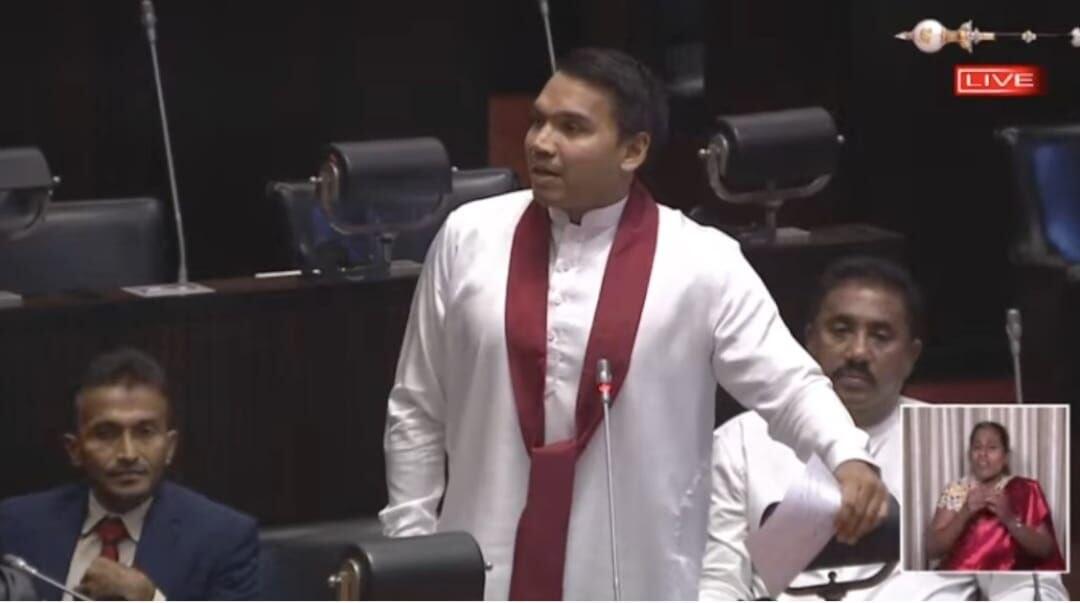
Sri Lanka Podujana Peramuna (SLPP) MP Namal Rajapaksa told Parliament on Tuesday that the proposed Organised Crime Prevention Bill could pave the way for repressive practices like those of 1988-89.
Rajapaksa, who was brought to Parliament from remand custody to attend the sitting, raised concerns over the provisions on how members of organised criminal groups are identified.
“Do you need a new law to arrest someone who has a tattoo displaying the symbol of an organised criminal gang?” he asked.
He referred to explanations by Justice Minister Harshana Nanayakkara on tattoos and other characteristics associated with criminal groups, and asked whether people could be targeted because of their appearance. He recalled earlier practices involving people identified as Island Reconvicted Criminals (IRCs), alleging that people had been targeted over their hairstyles and beards.
Rajapaksa alleged that the government was introducing repressive measures under the guise of combating organised crime. He pointed to continuing shootings and killings linked to organised crime, and said the government was failing to address the economic difficulties facing the public.
The SLPP MP urged the government to focus on unemployment, the rising cost of living and other pressing issues instead of introducing legislation which, he claimed, could be used for repression.
Background
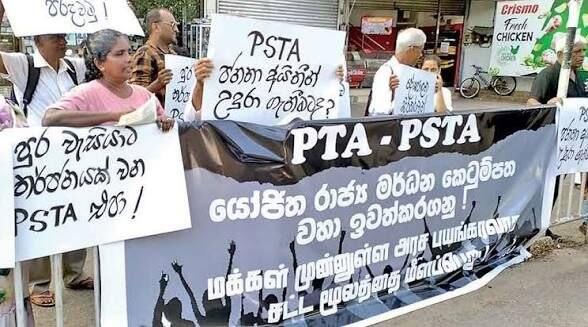
The Bill was gazetted on 6 October and has been presented to Parliament, according to Frontline Socialist Party (FSP) Education Secretary Pubudu Jayagoda, who criticised it at a media briefing in Nugegoda this week. He said it defines an organised criminal group as a structured group of three or more people acting together over a period of time to commit serious offences for financial or other material gain.
Jayagoda said a serious offence is defined as one carrying a prison sentence of four years or more, and that Section 4(2) could allow a person to be identified as a member of a criminal group based on clothing, gestures, language or tattoos. He said Section 20(1) would let police detain a suspect for up to 72 hours without producing the person before a Magistrate, and that Section 23 removes the Magistrate’s power to grant bail. These are his readings of the Bill.
The 1988-89 period refers to the second Janatha Vimukthi Peramuna (JVP) insurrection and the state’s response to it, which is associated with large numbers of killings and disappearances.
What it means
If the Bill is passed, it would change the powers police hold over people suspected of belonging to organised groups. Critics such as Rajapaksa and Jayagoda say the definitions are broad enough to affect ordinary people, including young people with tattoos or long hair.
The government’s stated aim, as cited in the debate, is to act against organised crime, which Rajapaksa himself linked to continuing shootings and killings. The Bill must be debated in Parliament before any vote.