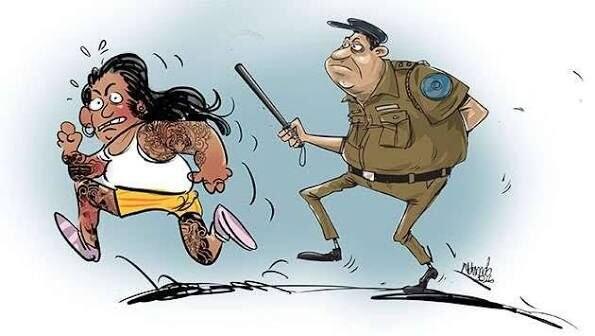
Wearing tattoos or styles of dress linked to organised criminal groups could count as evidence of membership under the Prevention of Organised Crimes Bill, which was presented to Parliament on 20 October.
The Bill allows a person to be identified as a member of an organised criminal group on the basis of certain characteristics, including tattoos and styles of dress associated with such groups. Wearing the uniform of a soldier, sailor or airman, assisting military deserters and obstructing public servants in the discharge of their duties are among the offences listed in its First Schedule.
Justice Minister Harshana Nanayakkara said the Bill would not restrict anyone’s right to choose their hairstyle or style of dress. He said, however, that adopting hairstyles or clothing associated with organised criminal groups would be treated as an offence under the proposed law.
The First Schedule also covers offences under the Financial Transactions Reporting Act No. 6 of 2006, offences under the Forest Conservation Ordinance, illegal gambling, advertising unlawful gambling, gambling involving underage persons, payment device fraud and computer crimes.
A police officer of the rank of Superintendent of Police or above could apply to a Magistrate for an order requiring a person to unlock a data storage device and provide access to the information on it. Police could also seek authorisation to intercept, read, listen to or record postal messages, emails, telephone calls and voice or video conferences.
Criticism from lawyers and opposition parties
The Bar Association of Sri Lanka (BASL) called on the government on 21 October to withdraw the Bill, together with the Protection of the State from Terrorism Bill, in their present forms. In a statement, BASL President Rajeev Amarasuriya and Secretary Nalin De Silva said the two Bills would give the Executive extraordinary powers of arrest, detention and surveillance.
The BASL said there had been no public consultation on the organised crimes legislation, and that it had not been consulted. It argued that the definitions of “serious crimes” and “organised criminal groups” were too broad. Under the Bill, a structured group of three or more people acting together for a financial or other material benefit could qualify, even without formal roles or continuous membership.
According to the BASL, the Bill would let the Secretary to the ministry in charge of the police order detention for up to two months at a time, to a maximum of one year, with bail available only through the High Court. It said a court would not decide whether detention was necessary before such an order was issued. It gave the example of an amateur band performing songs at a restaurant without the copyright holders’ permission, which it said could be treated as an organised criminal group on a literal reading.
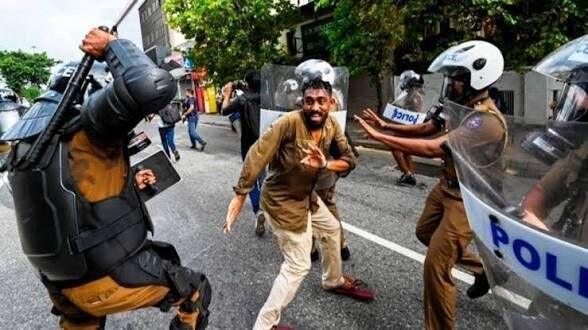
The Frontline Socialist Party (FSP) also raised concerns. Its Education Secretary, Pubudu Jayagoda, said offences such as unlawful second marriages, copyright violations, unlicensed gambling and prohibited activities in protected forests had been included in a law meant to tackle organised crime. “Is having a tattoo a crime in Sri Lanka?” he asked, and he questioned what would happen to people who already had tattoos. He also warned that the offence of obstructing police officers could be misused against protesters or citizens who intervene in alleged police misconduct.
The government says the legislation is intended to strengthen efforts against organised crime and to implement international obligations.
Background
Sri Lanka has no single law dedicated to organised crime. Offences such as drug trafficking, extortion and gambling are prosecuted under separate statutes. The new Bill gathers a wide range of offences under one framework and adds powers for investigators.
The BASL has also filed a Special Determination application before the Supreme Court challenging provisions of the terrorism Bill. Under Sri Lankan procedure, the Supreme Court examines whether a Bill passed through Parliament is consistent with the Constitution.
What it means
If passed in its current form, the law would apply to anyone suspected of belonging to a group of three or more people acting together for material gain, and the listed offences range from payment card fraud to illegal gambling.
The provisions on seizing and unlocking digital devices and intercepting communications would, as drafted, apply to people under investigation. Lawyers’ groups and opposition parties have asked for the Bill to be reconsidered before Parliament debates it.