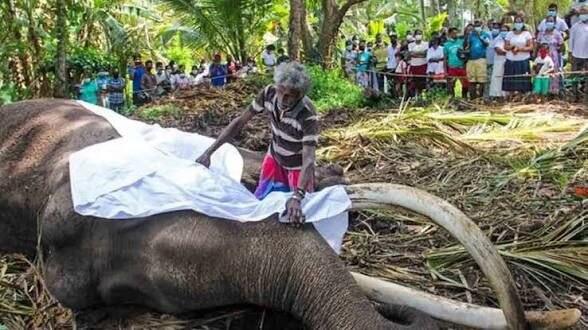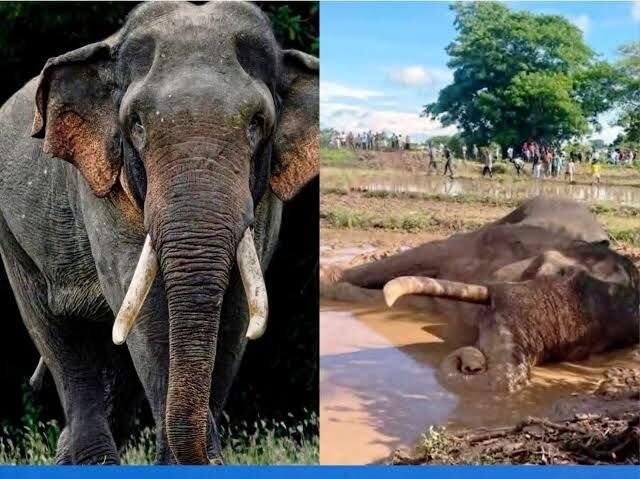
An expert committee appointed by President Anura Kumara Dissanayake to investigate the death of the tusker Kawanthissa held its first meeting at the Presidential Secretariat in Colombo on Wednesday.
The President’s Media Division (PMD) said the meeting was held under the patronage of Presidential Chief of Staff Prabath Chandrakeerthi. Committee Chairman A. H. Sarath Wijesinghe and Coordinator W. W. Harrison attended, along with academics, wildlife experts and legal professionals.
The PMD said members discussed the cause of the tusker’s death, the nature of the injuries it sustained and the role of the Department of Wildlife Conservation. Kawanthissa died on or around 16 October in the Siyambalangamuwa area of Galgamuwa.
The committee is also tasked with drafting a Standard Operating Procedure (SOP) for the welfare of wild elephants and recommending a national elephant conservation programme. According to the PMD, members discussed scientifically based procedures so that officials can act promptly in similar incidents, and the idea of a Rapid Response Veterinary Unit to give wild elephants immediate care in the field.
The committee also decided to seek help from local and international experts in developing the proposed conservation measures.
Separately, Opposition Leader Sajith Premadasa and several Opposition Members of Parliament signed a motion on Wednesday asking for a Special Parliamentary Select Committee on the death. The Opposition said the committee should establish the circumstances and determine whether all parties involved had carried out their responsibilities. It said the move is also meant to ensure accountability and justice. The motion is expected to go to the Speaker of Parliament.
Background
Tuskers are rare among Sri Lanka’s wild elephants, because only a small share of males carry tusks. Wild elephants are a protected species, and the Department of Wildlife Conservation is the state agency responsible for managing and protecting them.
Sri Lanka also records hundreds of wild elephant deaths every year, many linked to conflict with people over farmland and settlements. The death of a tusker considered part of the country’s natural heritage, as the Opposition described Kawanthissa, has drawn attention to how such cases are investigated.
Opposition Leader Sajith Premadasa had earlier called for a special task force to protect tuskers. A parliamentary select committee, if approved by the House, would have its own members from different parties and could summon officials.
What it means
The committee’s recommendations could shape how wildlife officers respond when an elephant is injured, including whether veterinary teams are posted close to the areas where such incidents are most common.
For communities in elephant range areas, a standard procedure and a national conservation programme could set out clearer duties for officials. No timeline for the committee’s report was given in the PMD statement, and the Opposition’s motion has yet to be tabled in Parliament.