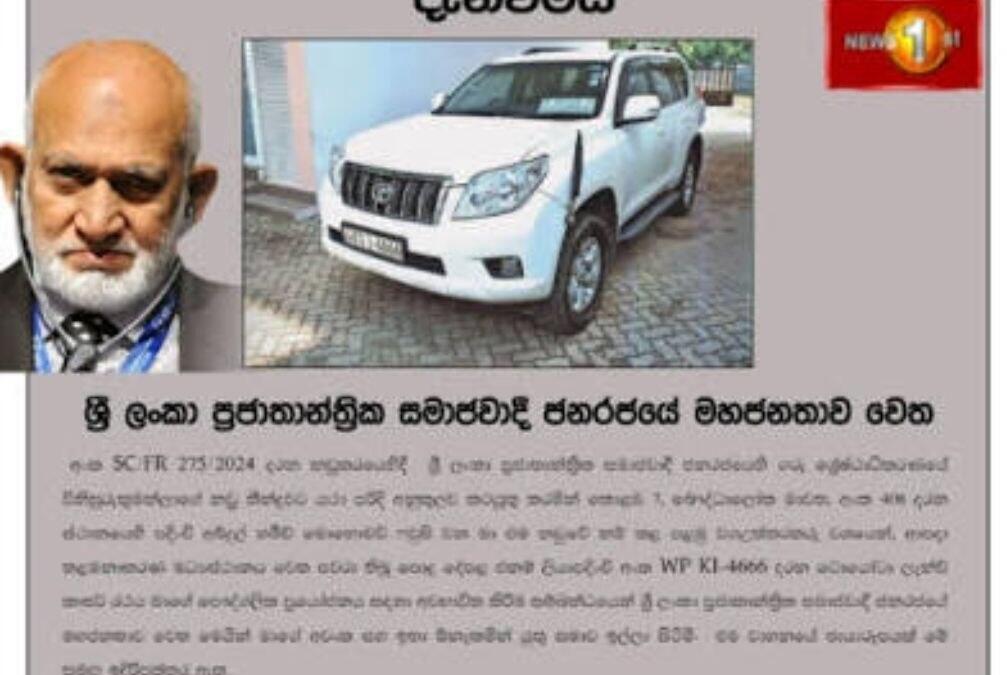
Former Disaster Management Minister A.H.M. Fowzie has published a public apology in a Sinhala-language state newspaper on Saturday, 24 October, as ordered by the Supreme Court.
The advertisement follows the court’s ruling of 29 September, which directed Fowzie to pay about Rs. 6.6 million to the state’s Consolidated Fund and to publish public apologies in Sinhala, Tamil and English newspapers.
The Supreme Court found that Fowzie had violated the fundamental right to equality guaranteed by Article 12(1) of the Constitution. It held that he used for personal benefit a vehicle that the Netherlands government had provided for Sri Lanka’s disaster management activities. The court described his conduct as a “textbook betrayal” of public trust.
The ruling was delivered by a three-judge bench made up of Chief Justice Preethi Padman Surasena and Justices Janak de Silva and Arjuna Obeyesekere.
The court also directed Fowzie to publish half-page apology advertisements, including a photograph of the vehicle, in the state newspapers Silumina, Sunday Observer and Thinakaran. The advertisement published on Saturday appeared in a Sinhala-language state newspaper.
The case was brought as a fundamental rights petition by Chandra Jayaratne, a former Chairman of the Ceylon Chamber of Commerce.
Background
Fundamental rights petitions are filed directly in the Supreme Court, which under the Constitution has the power to hear complaints that a person’s fundamental rights have been infringed by executive or administrative action. Such petitions are normally filed within a month of the alleged infringement, and the court can order compensation, costs or other remedies it considers just and equitable.
Article 12(1) of the Constitution provides that all persons are equal before the law and are entitled to the equal protection of the law. In this case the court applied that guarantee to the use of a vehicle intended for public disaster management work.
The Consolidated Fund is the main government account into which public revenue is paid and from which state spending is authorised by Parliament. A payment ordered into that fund goes to the state rather than to the petitioner.
Disaster management in Sri Lanka involves coordination between the ministry responsible, state agencies and foreign partners, who at times provide equipment and vehicles for emergency use. The court’s finding was that the vehicle in this case had been given for that purpose.
What it means
The ruling shows that Sri Lankan citizens can ask the Supreme Court to examine how public officeholders use state property, and that the court can order repayment to the state as well as public apologies. Equipment donated by foreign governments for public programmes is held for those programmes, and the decision confirms that its use for personal benefit can be challenged in court.
For readers, the publication of the apology is the step the court required to be taken in public. The court’s order also covers Tamil and English newspapers, and the report does not say whether those have yet appeared.