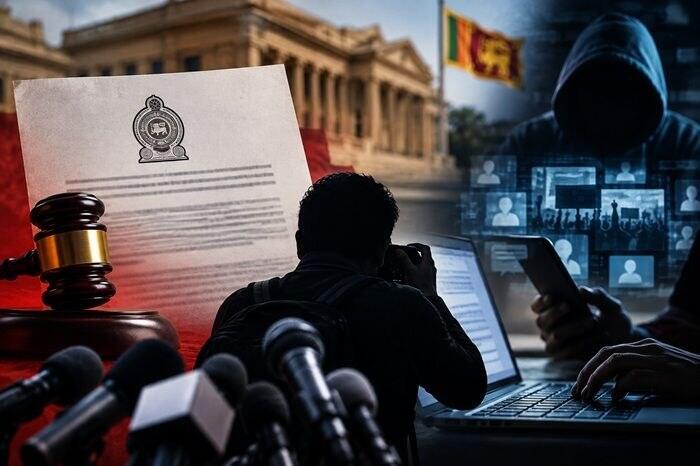
The Joint Opposition has said the Protection of State from Terrorism Bill would end media freedom in Sri Lanka, as the Government moves to enact it.
Joint Opposition Convener Prof. G.L. Peiris told a media briefing on Tuesday that the Government wanted to pass the legislation as soon as possible. He said it would affect media institutions, editors and journalists, and the lives of the wider population.
Prof. Peiris said a journalist’s job is to report information, and that reporting should not be treated as an act of influencing someone to do something. He said the Bill allows a media report to be considered an act of terrorism.
He said it was media personnel who revealed the disappearance of 323 containers and the purchase of inferior coal, and that journalists obtained such information from their sources. According to him, the Bill contains provisions that could compel journalists to reveal those sources, which he said could bring reporting to a halt.
Prof. Peiris also said the Bill provides for the banning of media briefings, rallies, seminars and similar events. The Government could prohibit such events and then report the matter to the courts, he said.
What the opposition objects to
Prof. Peiris described the Bill’s definition of terrorism as questionable and overly broad. “There is no other legislation in the world in which the definition of terrorism is so broad-based,” he said.
He said archaeological sites, public health and the power grid are listed as areas vulnerable to terrorism, but that no threshold of harm has been specified. In his words, “This puts everyone at risk.”
He said influencing the Government to do something or refrain from doing something could be considered an act of terrorism under the Bill. A person who commits an offence of this nature could face a prison sentence of 15 years or a fine of not less than Rs. 15 million, he said.
He further said the Defence Secretary would be empowered under the Bill to prohibit a person from entering any location. The Inspector General of Police (IGP) or a Deputy Inspector General of Police (DIG) could seek the Defence Secretary’s approval to arrest anyone suspected of engaging in terrorism, and such a person could be detained for two months without trial, he said.
Background
Sri Lanka’s counter-terrorism laws have been a subject of debate for years. The Prevention of Terrorism Act, enacted in 1979, has been criticised by human rights groups and foreign governments, and successive governments have spoken of replacing it with new legislation.
The figures and provisions cited in this report are those given by Prof. Peiris at the briefing. The Government’s response to the Joint Opposition’s claims was not part of the statement.
What it means
If the Bill is enacted in its present form, the provisions described by the Joint Opposition would apply to journalists, event organisers and members of the public, including Sri Lankans who take part in rallies or protests. The detention period of two months without trial, the penalty of 15 years or a fine of not less than Rs. 15 million, and the powers of the Defence Secretary are the points the opposition has singled out.
Parliament’s debate and vote will decide the Bill’s final wording.