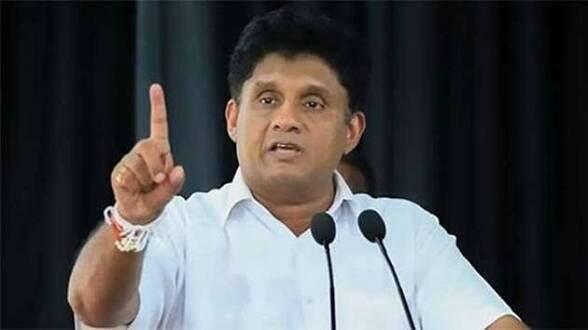
Opposition Leader Sajith Premadasa has accused the government of trying to curtail the fundamental and human rights of citizens through two new Bills on terrorism and organised crime.
Premadasa, who leads the Samagi Jana Balawegaya (SJB), made the remarks at an event at the Sri Subodhirajarama Viharaya in Kusumgama, Gallalla, in Polonnaruwa in the North Central Province, on Sunday.
He said citizens had the right to practise their religion, hold political beliefs, join political parties, express their views, hold meetings and take part in peaceful protests.
Premadasa alleged that the Protection of the State from Terrorism Bill and the Organised Crime Prevention Bill would undermine judicial authority and give excessive powers to the Executive. He claimed the legislation would let the Executive decide who could be classified as a terrorist or an organised criminal.
He further alleged that people could be targeted on the basis of their clothing, hairstyles or tattoos.
Premadasa said Sri Lanka needed legislation to combat terrorism in line with international conventions and agreements. He argued that the Bills now being introduced would instead violate fundamental and human rights, and accused the government of seeking to establish one-party rule and undermine democracy.
The Opposition Leader also criticised the government over what he described as interference with Buddhist monks and their robes. He said any action affecting monks should be taken only after proper consultation and in accordance with the relevant circulars, and accused the government of failing to apologise to the country over the incident.
Background
Sri Lanka has long used the Prevention of Terrorism Act of 1979 (PTA), which rights groups and international bodies have repeatedly criticised. Successive governments have promised to repeal it or replace it with new legislation, and the Protection of the State from Terrorism Bill is the proposal Premadasa was referring to.
Bills in Sri Lanka are published in the Gazette and presented to Parliament, where they are debated and put to a vote. Under the Constitution, citizens may challenge a Bill in the Supreme Court within a set period after it is placed on the Order Paper of Parliament, and the court then rules on whether its provisions are consistent with the Constitution.
Premadasa also noted that, under former President Ranasinghe Premadasa, a Cabinet Ministry for Buddha Sasana and separate State Ministries for other religions were established. He said those arrangements were later changed. He told the gathering that the Constitution gives Buddhism a special status while recognising and protecting other religions, ethnic communities and cultures.
What it means
Laws on terrorism and organised crime decide what police can do when they arrest, search or detain a person, and what rights a suspect has once in custody. Any change to these laws can therefore affect ordinary citizens, as well as people accused of serious offences.
The Bills are expected to be debated in Parliament, where members will be able to raise the concerns that Premadasa has outlined. Citizens and organisations can also follow the Gazette notices and the Order Paper to see when the Bills are scheduled.