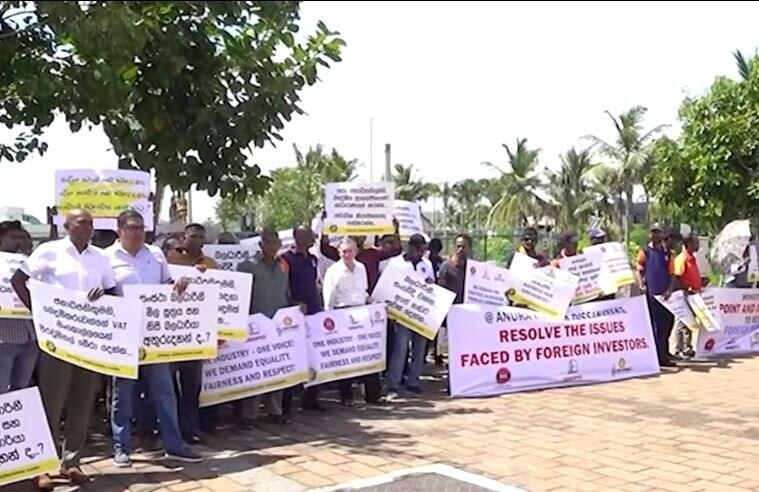
Dealers of Sinopec, RM Parks and Lanka IOC staged a silent protest in Colombo on Tuesday, alleging that the companies are not supplying their filling stations with enough fuel.
The protest was held outside the World Trade Centre. The dealers later gathered outside the Presidential Secretariat, where they handed in a letter setting out their grievances. They also moved to submit letters to the Ceylon Petroleum Corporation (CPC), the Chinese Embassy and the Indian High Commission, asking for help to resolve the distribution problems.
The dealers said the inadequate supplies were making it increasingly difficult to run their stations and could cause serious inconvenience to consumers. They also raised concerns about the fuel pricing mechanism, claiming that private companies were restricting supplies because they could not sell fuel profitably at current prices.
The dealers called for an independent authority to regulate fuel prices and to make the pricing formula transparent.
CPC Chairman D. J. Rajakaruna and the Secretary to the Ministry of Energy responded to journalists’ questions after an event in Colombo. Officials said private fuel companies had complained of financial losses under the existing pricing structure. They said the companies are allowed to raise certain fuel prices within limits set by the pricing formula, and that some operators had already raised the prices of Octane 95 petrol and Super Diesel.
Officials acknowledged that the government cannot directly control the quantities of fuel that private operators distribute under the existing arrangements. They said the CPC was taking steps to keep its own filling stations adequately supplied so that consumers face as little inconvenience as possible.
If the problem continues, the government will examine the legal provisions governing private fuel operators before deciding on further action, officials indicated. The CPC has maintained that the country has sufficient fuel stocks and is not facing an overall shortage.
Background
For many years, fuel retailing in Sri Lanka was led by the state-owned CPC and Lanka IOC, the local subsidiary of India’s Indian Oil Corporation. Other companies, including Sinopec and RM Parks, have since entered the retail market and operate their own networks of filling stations.
Domestic fuel prices are set under a pricing formula and are revised periodically. The dealers’ complaint centres on that mechanism: they say it leaves private suppliers unable to sell at a profit, while officials say the companies have room to raise some prices within the formula’s limits.
What it means
Motorists who use stations run by the private operators named in the protest may find supplies uneven while the dispute continues, according to the dealers. The CPC says its own stations are being kept supplied and that there is no overall shortage.
Prices of Octane 95 petrol and Super Diesel at some private operators have already gone up, officials said. Whether the government changes the rules for private operators will depend on its review of the legal provisions that govern them.