
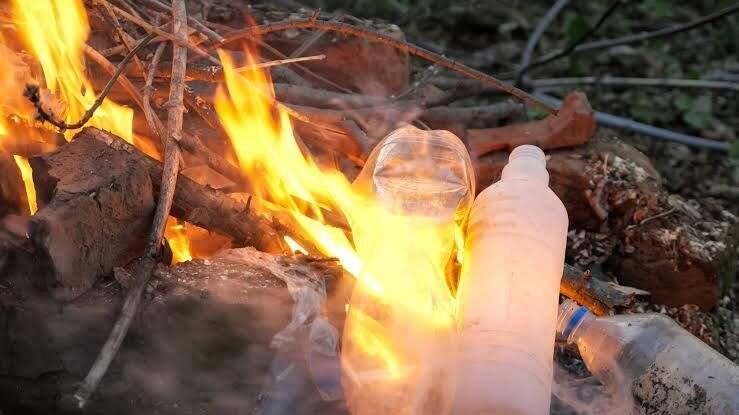
More than half of Sri Lankan households dispose of polythene and plastic waste by burning it, even though the National Environmental Act prohibits open burning, according to Department of Census and Statistics data.
The figures show that 52.5 percent of households burn such waste. Another 25.3 percent dispose of it through local authorities, 12.3 percent deal with it within their own premises and 9 percent hand it to waste collectors. A further 0.9 percent use other methods.
An official of the National Solid Waste Management Support Centre (NSWMSC) said the practice continues despite the ban, particularly in rural areas where monitoring and enforcement are difficult. He said it is watched more closely in urban areas and has declined over the years, although it has not stopped.
The official pointed to gaps in local authority waste collection, including too few staff and outdated or insufficient vehicles. He also said enforcement is hampered by the small number of Environmental Police personnel, which makes it hard to act against violators.
Local authorities run awareness programmes in all nine provinces on proper disposal, separation and recycling of plastic, and use social media to reach more people, the official said. They also collect residual waste, including plastic left behind by informal collectors who take away recyclable material to sell.
The Ministry of Public Administration, Home Affairs, Provincial Councils and Local Government has introduced a Material Recovery Facility (MRF) plan for 2025 to 2027. It aims to bring polythene and plastic waste to designated facilities for separation and recycling, which would reduce the amount released into the environment and discourage burning.
Background
The National Environmental Act, No. 47 of 1980, is the main law governing environmental protection in Sri Lanka. It prohibits the open burning of refuse or other combustible matter, including plastics, and Section 31 makes those who break the rules liable to prosecution.
Waste collection in Sri Lanka is largely the responsibility of local authorities such as municipal councils, urban councils and pradeshiya sabhas. Their capacity differs widely between towns and rural areas, which is one reason households in some areas deal with waste themselves.
Burning plastic is widely recognised by health and environmental agencies as a source of smoke and toxic fumes, which can irritate the lungs and affect people with breathing problems, children and older residents.
What it means
For households, the figures show that burning remains the most common way of getting rid of plastic waste, even though it is against the law. Residents who burn plastic can in principle be prosecuted under the Act, although officials say enforcement is limited outside urban areas.
The MRF plan is meant to give people a place to take plastic waste for sorting and recycling. Residents can ask their local authority about collection schedules, separation requirements and awareness programmes in their area.


