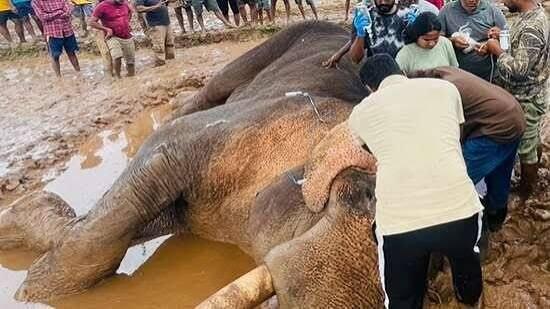
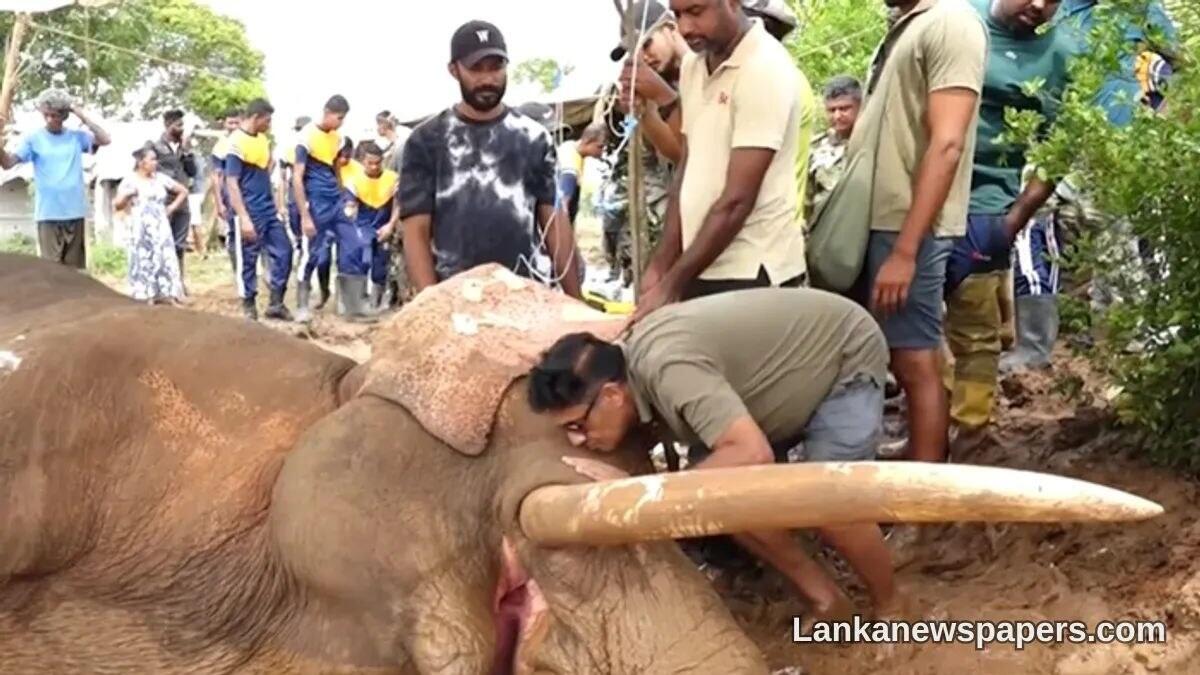
The Galgamuwa Magistrate’s Court on Saturday ordered a post-mortem examination to establish how the tusker Kavantissa died.
Acting Magistrate Kanchana Hathurusinghe directed veterinary officers to carry out the examination and submit a report to court. The court also ordered a formal investigation into the elephant’s death, with progress to be reported to it.
The Acting Magistrate directed that the carcass be buried securely on land belonging to the Department of Wildlife Conservation, in a way that would allow the tusks to be recovered in future, with adequate security at the burial site. The orders followed facts presented by a team of wildlife officers, including Meegalewa Wildlife Office Range Forest Officer W. Weerakoon. The case will be recalled before Galgamuwa Chief Magistrate Ravindra Ranjan Bandara on a later date.
Kavantissa died on Friday while being treated for an injury to its front right leg, after it was found collapsed in the Siyambalangamuwa area. The injury was reported to be a gunshot wound, and the elephant had been receiving veterinary treatment for several weeks.
Opposition Leader Sajith Premadasa visited Siyambalangamuwa on Saturday to pay his last respects. He urged the authorities to seek foreign experts for the post-mortem and said both local and foreign specialists should take part so that the investigation is transparent. Premadasa said he had named the elephant after encountering it near the Siyambalangamuwa reservoir several years ago.
Director General of Wildlife Conservation Ranjan Marasinghe defended the department’s protection efforts. “We estimate that this elephant was over 45 years old. In the wild, elephants generally live for a maximum of 50 to 60 years. In human terms, he was like an 80-year-old person,” he said. He rejected suggestions of a complete failure to protect the animal.
Background
Environmentalists and opposition politicians have called for an independent investigation into who shot the tusker, the treatment it received and the circumstances of its death. Marasinghe said the department had earlier tried to fit GPS tracking collars on more than 100 elephants but met practical difficulties. Fitting a collar requires the animal to be tranquillised, which he said can pose health risks, particularly for older animals.
Dr. Jagath Jayasekara, a former veterinary officer at the Dehiwala National Zoological Park, said treating a wild elephant weighing four to five tonnes is difficult and risky. He said vets often cannot carry out routine tests in the field, such as ECGs and blood tests. Antibiotics and painkillers may first be given from a distance using tranquilliser guns, and the animal’s weight has to be estimated from its body size and footprints to set the dose.
Dr. Jayasekara said vets may then have to track the elephant over several kilometres for days to continue treatment. Moving a sick elephant of several tonnes to a hospital is also extremely hard, so treatment usually has to be given where the animal is found. Despite the efforts of the veterinary team, Kavantissa became too weak to stand and died.
Wild elephants are protected by law in Sri Lanka, and gunshot injuries are among the threats the Department of Wildlife Conservation says elephants face across the country.
What it means
The post-mortem report and the court-ordered investigation are the next steps. The court has asked for both to be reported to it, so the findings are expected to come before the Galgamuwa court when the case is next called.
For communities that live alongside elephants, and for the wildlife tourism that depends on well-known tuskers, the case has put questions about how the state protects individual animals and responds to shootings on the public record. The Director General has said the department’s aim is to protect the whole elephant population.