
Justice Minister Harshana Nanayakkara told Parliament that a report by Prof. Raj Somadeva on the Chemmani mass grave is an archaeological document, not a medico-legal report, and cannot decide how the dead died.
He was replying to a question from MP Ramanathan Archchuna, who asked whether Prof. Somadeva had the professional qualifications to issue a medico-legal report. “No, he doesn’t and he never issued one also,” Nanayakkara said, adding that the question itself had caused the confusion.
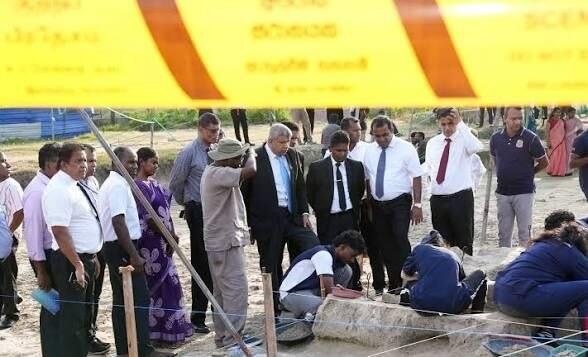
The minister said remains of approximately 574 individuals had been recovered from the Chemmani site over several phases of excavation. Prof. Somadeva led the work in the presence of the Jaffna Magistrate, lawyers for various parties, Jaffna Teaching Hospital Judicial Medical Officer Dr. Pranavan Selliah, Criminal Investigation Department (CID) officers and scene-of-crime officers.
Nanayakkara said the Jaffna Magistrate had directed Dr. Pranavan and his team to prepare a judicial forensic report on the remains, and that this work is under way. He said the cause and manner of death would be examined through medico-legal investigations in due course.
Following objections from lawyers representing the families of the disappeared, the Magistrate ordered that Prof. Somadeva’s report be placed on the case record but not acted upon on its own, the minister said. “The Magistrate cannot make an order based on one report,” he said.
Nanayakkara said the government had not formally agreed to set up or facilitate an independent international investigation, and that no such request had been made by parties before the court. He said the government was willing to seek international technical and forensic help, particularly for DNA analysis and identification of remains, depending on what the court requires.
He rejected suggestions that the findings were aimed at the Tamil community and appealed to MPs not to politicise the investigation. “We want to find the truth, we want justice,” he said.
Background
Chemmani, in the Jaffna District of the Northern Province, has been the site of excavations since human remains were found there in 2025. The site has drawn close attention from families of people who went missing during and after the war, and from rights groups.
A forensic archaeologist studies where, how and in what circumstances remains were buried. A judicial medical officer, by contrast, examines remains to determine the cause and manner of death. Courts in Sri Lanka can receive both kinds of report in the same case.
The Office on Missing Persons (OMP) is monitoring the excavations as an observer under Section 12(d) of the OMP Act, the minister said.
What it means
For the families of the disappeared, many of them in the Northern Province and among the Tamil diaspora, the case is likely to turn on the judicial forensic report and the Magistrate’s orders rather than on the archaeological findings alone.
The minister’s statement indicates that identification work, including DNA analysis, could involve foreign technical assistance if the court asks for it. No such request has been made so far, according to the minister.


