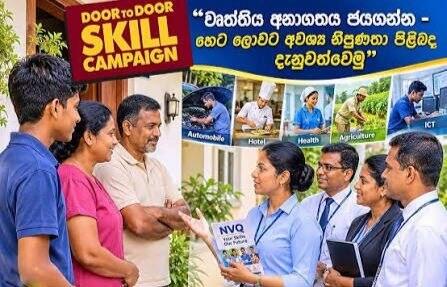
A national door-to-door campaign to steer young people into vocational training and jobs will cover all 14,008 Grama Niladhari divisions in Sri Lanka.
The National Vocational Skills Promotion Programme, also called the “Door to Door Skill Campaign”, is being carried out by the Vocational Education Division of the Ministry of Education, Higher Education and Vocational Education, with support from the Ministry of Social Empowerment.
The programme aims to reach young people who are unemployed or who cannot progress through the conventional education system, and to help them build vocational skills that match labour market needs.
Under the initiative, officials will visit villages and households to identify the talents and interests of young people. They will also explain vocational education and the training opportunities available to young people and their parents.
Deputy Minister of Vocational Education Nalin Hewage said the programme was expected to strengthen young people’s vocational skills, connect them with employment and contribute to national economic development.
He said the Government was focusing on higher allocations for education, strengthening human resources in the education and vocational education sectors, expanding higher education opportunities through National Vocational Qualification (NVQ) pathways, and supporting young people facing economic difficulties.
The Government also aims to build a skilled youth workforce to support its national targets of US$30 billion in export revenue and four million tourists by 2030, the Deputy Minister said.
The programme was officially launched at Isurupaya on 21 November. Prime Minister and Education Minister Dr. Harini Amarasuriya attended the opening event.
Background
A Grama Niladhari division is the smallest unit of local administration in Sri Lanka. Each is headed by a Grama Niladhari, an official who works at village level and handles tasks such as maintaining local records and certifying documents. Reaching all 14,008 divisions means the campaign is designed to cover the whole island, including areas far from towns and training centres.
The National Vocational Qualification framework sets out levels of skill recognised across the country, so that a certificate gained at a training institute can be compared with others and used when applying for jobs or further study. Vocational courses are offered through a number of State institutions and are generally aimed at people who want a practical qualification rather than a university degree.
Youth unemployment and the gap between what training courses teach and what employers need have been recurring concerns in the labour market. The Deputy Minister’s remarks link the campaign to the Government’s wider economic targets for exports and tourism, both of which depend on a trained workforce.
What it means
For young people who left school without a clear path to work, the campaign means officials may visit their homes to explain what vocational courses are available and how to enrol. Parents are also among those the visits are intended to reach.
The programme does not on its own create jobs, and the Ministry has not said in the facts available how many places or courses will be offered. Families who want details can ask their Grama Niladhari or the Vocational Education Division of the Ministry of Education, Higher Education and Vocational Education.