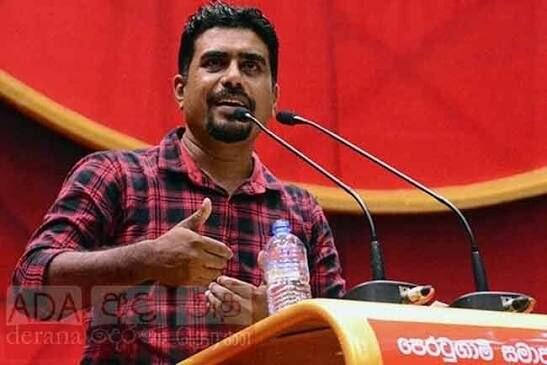
The Frontline Socialist Party (FSP) has said that the JVP-led government has abandoned the socialist ideals of the generation that died in the 1988-89 insurrection and is following a neoliberal economic programme.
FSP Mass Secretary Duminda Nagamuwa made the remarks on Friday at the party’s 37th Il Maha Viru Samaruwa commemoration at the Yakkala Urban Council Hall. He said there was a serious contradiction between the political aims of those who gave their lives for a socialist transformation and the policies of the present government.
Nagamuwa said the movement of Rohana Wijeweera and Upatissa Gamanayake was now in power, but he questioned whether its policies matched the objectives for which that generation had fought. “The dream of the generation that sacrificed lives was socialism,” he said.
He alleged that the open economy introduced after 1977 had weakened local small businesses and the public sector while favouring large private firms. He linked this to the 1978 Constitution, the executive presidency and the Prevention of Terrorism Act (PTA), and alleged that these measures had been used to protect a neoliberal model.
Nagamuwa also accused the government of moving to strengthen State repression despite the JVP’s past opposition to the PTA. He criticised the Protection of the State from Terrorism Bill and the Prevention of Organised Crime Bill, saying the government had promised to repeal the PTA. He claimed the proposed laws could threaten democratic rights and that public opposition had forced the government to reconsider parts of them.
On the economy, he alleged that the programme backed by the International Monetary Fund (IMF) placed a disproportionate burden on ordinary people while benefiting wealthy business interests. He questioned whether the 2027 Budget gave enough relief to people facing a high cost of living, and said the government’s slogan, “A Thriving Nation: A Beautiful Life”, could not be judged by macroeconomic indicators alone.
He further alleged that foreign powers, including India and the United States, were influencing Sri Lanka’s economic and political decisions. Nagamuwa warned that continuing hardship and political dissatisfaction could lead to another popular uprising, and alleged that the government was strengthening repressive laws in anticipation of this.
Background
The JVP, or Janatha Vimukthi Peramuna, led an armed uprising against the government in 1987-89 that ended with the deaths of thousands of people, including its leader Rohana Wijeweera. The party now leads the National People’s Power government under President Anura Kumara Dissanayake. The FSP is a separate party formed by a group that broke away from the JVP.
The Il Maha Viru Samaruwa is a commemoration held in November for those killed in that period. Sri Lanka has been following an IMF-backed programme since 2023, and the 2027 Budget was presented to Parliament in the past few days.
What it means
The FSP’s criticism centres on two issues that affect households directly: the cost of living and the terms of the IMF programme. The party says the Budget has not eased the burden on ordinary people, a view the government will be asked to answer in the Budget debate.
The two security-related bills Nagamuwa named would, if passed, replace or add to existing powers over arrest and detention. His claim that they could threaten democratic rights is the FSP’s position and not an established finding.