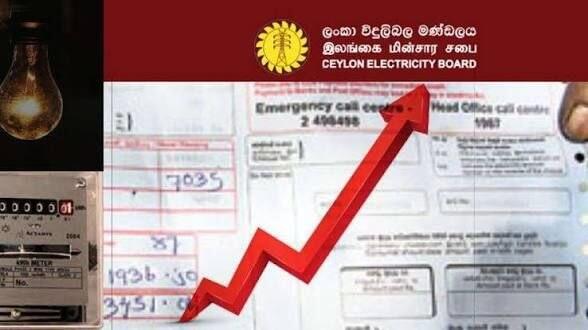
The Public Utilities Commission of Sri Lanka (PUCSL) has proposed a 1.46 percent increase in electricity tariffs for the fourth quarter of 2026, from October to December.
The proposal follows a preliminary review of cost and revenue forecasts submitted by electricity sector licensees. A stakeholder consultation on it will be held at the Bandaranaike Memorial International Conference Hall (BMICH) in Colombo on 5 November.
The PUCSL said the sector’s forecast cost of supply for the quarter is Rs. 157.3 billion, against expected revenue of Rs. 154 billion from electricity sales. The revenue figure includes a deficit of Rs. 1.1 billion brought forward from the previous period.
The National System Operator (NSO) and Electricity Distribution Lanka (Pvt) Ltd. (EDL) had submitted figures pointing to a required increase of 2.88 percent. The PUCSL cut this to 1.46 percent after removing a rise in generation capacity costs attributed to Electricity Generation Lanka (Pvt) Ltd. (EGL) and revising the estimated extra costs from the use of substandard coal in the second quarter of 2026.
The NSO forecasts demand of 4,796 million units. It expects major hydropower to supply 32.34 percent of generation and coal 25.68 percent. Other renewable sources are forecast to supply 28.81 percent, furnace oil 8.94 percent, naphtha 3.65 percent and diesel 0.58 percent.
The NSO estimates generation cost at Rs. 117.29 billion, of which energy cost is Rs. 98.3 billion. It projects generation capacity costs of Rs. 19 billion, which is Rs. 1.1 billion more than the Commission approved for the third quarter. Rs. 700 million of that rise is attributed to EGL plants, which operate without Power Purchase Agreements.
Background
The PUCSL is the regulator that reviews and approves electricity tariffs in Sri Lanka. Tariffs are examined against forecast costs and revenues under its tariff methodology, and the Commission invites public comment before taking decisions.
In its preliminary assessment the PUCSL identified several matters for further examination. They include whether the hydropower forecasts match rainfall predictions and how battery energy storage systems (BESS) would affect renewable generation. The NSO has included Rs. 703 million in capacity costs for BESS, based on 160 MW of storage being connected in phases.
The Commission also raised concerns about fuel pricing. It said EGL has yet to sign a Fuel Supply Agreement and that the agreements covering the Westcoast and Sobadhanavi power plants have no transparent pricing provisions. As a result, liquid fuel generation cost forecasts depend on pricing assumptions made by the Ceylon Petroleum Corporation.
EDL asked for Rs. 2.1 billion in additional costs outside the multi-year tariff framework, including Rs. 1.1 billion for loan repayments under the Supporting Electricity Supply Reliability Improvement Project. The PUCSL excluded the amount from its preliminary assessment, saying costs of work in progress should be recovered through tariffs only after the assets are completed and capitalised.
What it means
The figure is a proposal and not a final decision. Households and businesses will see a change in electricity charges only if the Commission approves a revision after the consultation.
Anyone wishing to comment on the generation mix, fuel prices, generation and capacity costs or battery storage costs can speak at the consultation. Each speaker will have about 10 minutes and may present in Sinhala, Tamil or English. Cross-examination of representations will not be permitted.