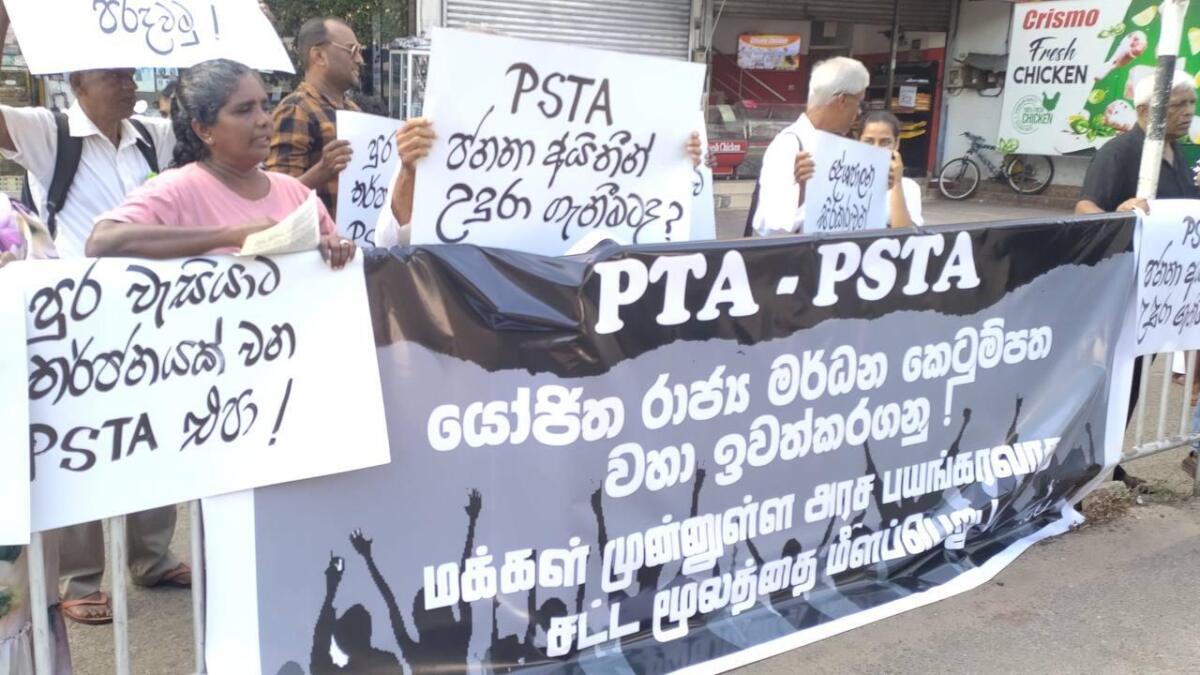
The UN Human Rights Office has said Sri Lanka’s proposed Protection of the State from Terrorism (PSTA) Bill could facilitate arbitrary detention, restrict freedom of expression and raise the risk of torture.
In a 19-page assessment dated 13 October, the Office reviewed the Bill gazetted on 22 September. It acknowledged improvements over earlier drafts but said the text still reproduces or expands several shortcomings of the existing Prevention of Terrorism Act (PTA).
The Office called on the Government to review the Bill substantially before it is enacted, with meaningful consultation involving civil society, independent institutions and legal experts.
One main concern is the power given to the Secretary to the Ministry of Defence to authorise detention for up to two months at a time, for a maximum of one year. Extensions beyond the first two months would need High Court approval, but the Office said the initial decision would stay with the executive rather than an independent court.
The Office also noted that suspects could be produced before a Magistrate up to 48 hours after arrest by police and up to 72 hours after arrest by the armed forces. It recommended that all suspects be produced before a Magistrate as soon as possible, ordinarily within 24 hours, whichever authority made the arrest.
It warned that broadly worded terrorism-related offences could be used against journalists, human rights defenders, civil society organisations and people taking part in peaceful protests. It singled out provisions on confidential information and terrorist publications, saying they could criminalise legitimate reporting on security operations, arrests and investigations, and called for explicit protection of journalistic sources and public-interest reporting.
The Office also questioned the arrest and search powers given to the armed forces and the Coast Guard. It said such powers could increase the risk of arbitrary detention, torture and enforced disappearance, particularly where suspects remain in military custody without adequate safeguards.
The assessment further questioned provisions that allow the President to proscribe organisations and allow authorities to restrict movement, public gatherings and communications. The Office said vaguely defined powers could be used against peaceful assembly and political dissent, and asked for stronger judicial oversight, clear time limits and independent review.
The Office welcomed several changes in the latest draft. These include removing police confessions as admissible evidence, extra protections for journalism and civil society activity, and mandatory audio-visual recording of police interviews. It also noted a requirement to notify the Human Rights Commission of Sri Lanka of arrests and detentions within 48 hours.
It said these changes did not adequately address its broader concerns, and warned that transitional provisions could let pending PTA cases and certain existing regulations continue after the PTA is repealed. The Office said it remained ready to provide technical assistance.
Background
The PTA has been in force in Sri Lanka since 1979 and has long been criticised by United Nations bodies and rights groups, who have repeatedly called for its repeal.
The PSTA Bill is intended to be that replacement. Once a Bill is gazetted, it can be challenged before the Supreme Court and must then be debated and passed by Parliament before it becomes law.
What it means
The provisions the Office highlights cover how long a person can be held before seeing a judge, who can order detention, and what journalists and protesters may lawfully do. Changes to any of these would apply to ordinary people as well as to those suspected of terrorism offences.