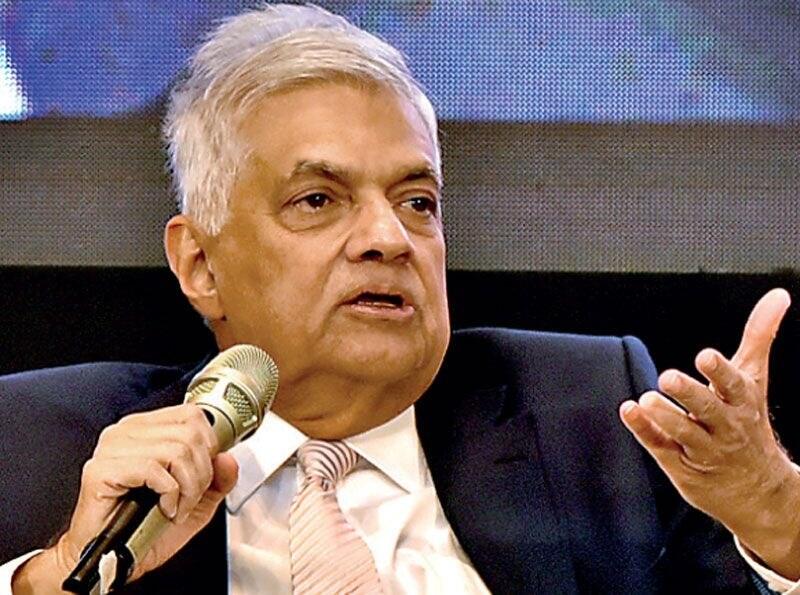
Former President Ranil Wickremesinghe has urged Sri Lanka to join BRICS and make closer economic cooperation with India a national priority as global power shifts towards Asia.
He was addressing the 50th webinar of the International Chamber of Commerce Sri Lanka (ICCSL). Wickremesinghe said Sri Lanka must adapt to what he described as emerging geopolitical realities through technological modernisation, regional economic integration and stronger partnerships with major powers.
He described India as the dominant power in the Bay of Bengal region and noted its place among the world’s three largest economies by gross domestic product. He said the Indian Ocean would become one of the centres of a new global order, driven by the economic rise of Asia and Africa.
Wickremesinghe referred to remarks by Indian Prime Minister Narendra Modi at the NDTV World Summit, where Modi described the present global situation as a transition between two world orders. According to Wickremesinghe, Modi pointed to the growing use of finance, trade, technology and shipping as tools of geopolitical influence, and quoted the ancient Indian strategist Chanakya on the need to prevent Matsya Nyaya, or the law of the fishes, under which the strong swallow the weak.
“We in Sri Lanka must adapt to these changes, or we will be swallowed up by bigger fish,” Wickremesinghe said.
His proposals included making Sri Lanka a maritime logistics centre, building closer ties with Bay of Bengal and Southeast Asian countries, joining BRICS, and strengthening relations with the United States, China, Russia and Japan. He also called for a review of how effective the Indian Ocean Rim Association (IORA) and the Bay of Bengal Initiative for Multi-Sectoral Technical and Economic Cooperation (BIMSTEC) are, and for faster work by the Colombo Security Conclave.
On technology, he said advances in artificial intelligence and computing were becoming central to national sovereignty, with the United States and China the two leading powers. He also called for a technologically advanced Sri Lankan Navy equipped with small and medium-sized vessels, with priority given to protecting undersea communication cables.
“Either we go this way, or we fade into insignificance, like one of the small Pacific islands,” he said.
Background
Wickremesinghe served as President from July 2022 until September 2024, when Anura Kumara Dissanayake took office after the presidential election. His government managed Sri Lanka’s debt restructuring and the early stages of its economic recovery after the 2022 crisis.
BRICS is a grouping of large emerging economies that has expanded in recent years. Sri Lanka has previously expressed interest in joining it. BIMSTEC links Sri Lanka with Bangladesh, Bhutan, India, Myanmar, Nepal and Thailand. The Colombo Security Conclave began as a security cooperation forum bringing together India, Sri Lanka and the Maldives, and has since widened its membership.
What it means
The proposals are Wickremesinghe’s own views and are not government policy. India is one of Sri Lanka’s closest neighbours and largest trading partners, so decisions on trade, investment and regional groupings can affect import prices, export markets and job opportunities in Sri Lanka. Any move to join BRICS or to reshape regional bodies would need a decision by the government and, in some cases, agreement from existing members of the groups concerned.