
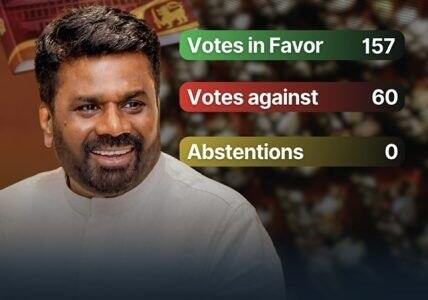
Parliament passed the second reading of the 2027 Budget by 157 votes to 60 on November 20, a majority of 97, after a seven-day debate.
The vote was taken at 6.30 pm. The debate began on November 13, a day after President Anura Kumara Dissanayake, in his capacity as Minister of Finance, Planning and Economic Development, presented the Budget.
The Committee Stage debate on the third reading began on November 21 and will continue until December 14. Parliament will meet at 9.30 am each day, including Saturdays, except on Sundays and public holidays.
During the Committee Stage debate, Prime Minister Dr. Harini Amarasuriya rejected Opposition allegations that the Budget had cut funding for education and schoolchildren. She said the Government had continued the Suraksha insurance scheme while expanding its coverage, and had increased Mahapola scholarships and student allowances.
“There should be criticism, but not lies,” the Prime Minister said, adding that it was regrettable that attempts were being made to popularise false narratives by abusing the privileges of Parliament.
Background
The 2027 Budget is the third presented by the National People’s Power (NPP)-led Government and the 81st Budget in Sri Lanka’s history.
It projects a budget deficit of Rs. 1.753 trillion, equivalent to 4.5% of Gross Domestic Product (GDP). Total government expenditure is estimated at Rs. 7.933 trillion, compared with Rs. 7.309 trillion in the revised estimates for 2026. Government revenue and grants are projected at Rs. 6.18 trillion, while total revenue is estimated at Rs. 6.15 trillion.
In Sri Lanka’s Parliament, a Budget is debated in stages: the second reading covers its general principles, the Committee Stage examines the allocations in detail, and the third reading is the final vote.
What it means
The Committee Stage is where allocations for individual ministries and programmes, including education support such as Mahapola scholarships and student allowances, are debated line by line before the final vote.
The Budget is being debated as inflation rises. Central Bank Governor Dr. Nandalal Weerasinghe said on November 20 that headline inflation is likely to exceed 9% by the end of this month and remain around that level in the near term. He said this is higher than the Central Bank expected when its Monetary Board decided to tighten monetary policy in May, when it had expected inflation to stay below 8% before returning to its 5% target in the first half of 2027.
Dr. Weerasinghe said the Board tightened monetary policy again at its latest meeting to bring inflation back to the target sooner and to prevent prolonged uncertainty and volatility.


